Spoon puns have a simple kind of magic: they take an everyday kitchen object and give it a whole new personality. Whether you need a clever caption, a silly text, a funny greeting-card message, or a joke that deserves a spot at the dinner table, spoon wordplay is surprisingly versatile.
This collection is updated for 2026 and packed with original spoon jokes designed to be funny without sounding forced. You’ll find clever spoon puns, cute lines, food-related jokes, spoon one-liners, birthday messages, teacher jokes, social media captions, and plenty of playful ideas for conversations.
People love this type of humor because spoons are familiar. Everyone knows what a spoon does, so the joke can focus on twisting familiar words like stir, scoop, ladle, silverware, table, bowl, and handle into unexpected punchlines.
You can use these jokes on Instagram, TikTok, Facebook, birthday cards, greeting cards, classroom boards, family group chats, conversations with friends, marketing campaigns, blog posts, and even food-themed content.
Quick Answer: What Are Spoon Puns?
Spoon puns are jokes and playful phrases built around words connected to spoons, eating, cooking, stirring, scooping, bowls, and silverware. They work by twisting familiar meanings into unexpected punchlines. For example, “I’m really attached to my spoon—it has a great handle on things” turns an ordinary spoon feature into a playful expression.
What’s Inside
| Section | What You’ll Find |
|---|---|
| Funny Spoon Puns | Everyday jokes for laughs |
| Clever Spoon Puns | Smart wordplay and witty lines |
| Cute Spoon Puns | Sweet messages and adorable jokes |
| Spoon One-Liners | Short jokes and quick captions |
| Spoon Dad Jokes | Groan-worthy family humor |
| Food Spoon Puns | Jokes about bowls, desserts, and meals |
| Birthday Spoon Puns | Funny birthday messages |
| Spoon Puns for Teachers | Classroom-friendly humor |
| Social Media Spoon Captions | Instagram, TikTok, and Facebook ideas |
| Spoon Love Puns | Romantic and flirty wordplay |
| How to Create Spoon Puns | A simple guide to making your own |
| FAQs | Common questions about spoon wordplay |
What Are Spoon Puns?
Spoon puns are a form of wordplay that uses the language surrounding spoons and eating to create a humorous double meaning. The trick is not necessarily to make the spoon itself funny. Instead, the humor comes from connecting spoon-related words to familiar phrases.
Think about words such as stir, scoop, handle, bowl, silver, serving, table, dish, taste, bite, and spoonful. Each one can lead somewhere unexpected.
For example, “I can handle this” is normally a statement about managing a situation. Add a spoon and suddenly handle has a literal meaning too. That gives the writer two meanings to play with.
Good spoon puns also work because they are easy to understand. You don’t need a complicated setup or a long explanation. The reader recognizes the ordinary phrase, notices the twist, and gets the joke.
From a humor-writing perspective, that simplicity is useful. The best puns often take something completely ordinary and make you look at it differently for a second.
Spoon puns can be silly, clever, romantic, wholesome, sarcastic, or intentionally cheesy. That makes them useful for almost any casual situation.
Here are a few examples:
- “I’ve got a handle on breakfast.”
- “Let’s stir things up a little.”
- “You’re my favorite spoon-mate.”
- “This conversation needs a little more stirring.”
- “I’m scooping up some good vibes.”
- “Life is better when you have something to spoon about.”
The goal is always the same: start with familiar language and give it a playful twist.
Why Are Spoon Puns So Popular?
Spoon humor works because spoons are part of everyday life. They appear at breakfast, lunch, dinner, dessert, coffee breaks, restaurants, school cafeterias, and family tables. That gives writers a huge collection of familiar situations to turn into jokes.
In real conversations, people usually use puns like these when they want to make an ordinary moment more playful. Someone eating soup might say they are “deeply invested in this situation.” A friend serving dessert might “scoop up the attention.” A parent might make a spoon joke simply because they know everyone at the table will groan.
From humor-writing experience, the strongest spoon jokes tend to combine a common phrase with a literal spoon-related meaning. That gives the reader a quick “aha” moment.
Spoon puns are also popular online because they are short. A good caption doesn’t need three paragraphs to work. A line such as “Scoop there it is” can fit naturally beneath a dessert photo.
They also work well for brands. Restaurants, ice cream shops, cafés, food bloggers, kitchen brands, and cooking creators can use spoon wordplay without making their content feel overly promotional.
Most importantly, spoon puns are flexible. You can make them cute for a birthday card, clever for a blog headline, wholesome for kids, romantic for a partner, or deliberately cheesy for a dad-joke collection.
Funny Spoon Puns
Funny spoon puns don’t need complicated setups. The best ones take ordinary spoon behavior and connect it to everyday expressions. That is what makes them easy to use at the dinner table, in a text message, or as a quick social caption.
These jokes lean into the silliness of the object itself. A spoon scoops. It stirs. It has a handle. It spends time in bowls. Once you start treating those ordinary details like personality traits, the possibilities become surprisingly large.
The following jokes are designed to sound natural enough for conversation while still having a clear punchline. They can also be adapted for captions, cards, classroom jokes, and food-themed posts.
🥄 Pun: “I’ve really got a handle on breakfast.”
Meaning: The joke uses “handle” to mean both understanding or controlling something and the physical handle of a spoon.
Why It’s Funny: It turns a common expression into a literal spoon reference. The phrase sounds normal until the spoon connection clicks.
Best Used For: Breakfast captions, kitchen jokes, food blogs, or a silly morning text.
🥄 Pun: “My spoon and I are in a committed relationship. It always comes through when things get soupy.”
Meaning: The spoon is treated like a dependable partner, especially when soup enters the picture.
Why It’s Funny: The serious relationship language clashes with the completely ordinary task of eating soup.
Best Used For: Food posts, funny messages, or conversations about soup.
🥄 Pun: “I tried to tell my spoon a secret, but it kept stirring things up.”
Meaning: “Stirring things up” normally means causing excitement or trouble, but stirring is also one of a spoon’s basic jobs.
Why It’s Funny: The spoon is given the personality of someone who can’t resist gossip.
Best Used For: Social captions, playful texts, and kitchen humor.
🥄 Pun: “I’m not being dramatic. I just have a lot on my spoon.”
Meaning: This twists the expression “a lot on my plate” into a spoon-related version.
Why It’s Funny: The phrase sounds like a serious complaint until the tiny spoon substitution makes it ridiculous.
Best Used For: Busy-day captions, office humor, and relatable posts.
🥄 Pun: “My spoon has excellent taste. It keeps choosing me.”
Meaning: “Taste” refers both to food and having good judgment.
Why It’s Funny: The spoon is portrayed as having personal preferences, as though it deliberately picked its owner.
Best Used For: Cute captions, kitchen posts, and playful conversations.
🥄 Pun: “I asked my spoon for advice. It told me to take things one scoop at a time.”
Meaning: The joke turns the spoon into a wise counselor and connects scooping with taking life slowly.
Why It’s Funny: Giving serious life advice to a spoon makes the ordinary object unexpectedly inspirational.
Best Used For: Motivational humor, Instagram captions, and lighthearted messages.
Clever Spoon Puns
Clever spoon puns rely more on word association than simple silliness. They work especially well when the reader recognizes the original expression before noticing how the spoon changes it.
Words like handle, stir, scoop, serve, bowl, silver, table, and spoonful give you plenty of opportunities for double meanings. The trick is to keep the sentence smooth. If the reader has to decode the joke for too long, the punchline loses its impact.
These examples are slightly sharper and more polished, making them useful for writers, bloggers, food creators, and anyone who wants a pun that feels intentional rather than random.
🥄 Pun: “I prefer to handle my problems with a spoon.”
Meaning: “Handle my problems” means deal with them, while a spoon literally has a handle.
Why It’s Funny: It takes a normal expression and gives it a ridiculous physical solution.
Best Used For: Clever captions, kitchen humor, and short-form content.
🥄 Pun: “Every good meal needs a little spoon-sense.”
Meaning: This plays on “common sense” by replacing the familiar word with “spoon.”
Why It’s Funny: The unexpected combination sounds almost like a real phrase.
Best Used For: Food blogs, restaurant posts, and clever kitchen captions.
🥄 Pun: “I’m trying to stay balanced, but my spoon keeps taking sides.”
Meaning: The joke treats the spoon as if it could choose sides in an argument.
Why It’s Funny: A completely inanimate utensil is suddenly involved in human conflict.
Best Used For: Sarcastic posts, playful arguments, and social media captions.
🥄 Pun: “The spoon knew the recipe by heart—it had a handle on every step.”
Meaning: “Had a handle on it” means understood something well.
Why It’s Funny: The phrase works naturally in a cooking context while also referencing the spoon’s physical design.
Best Used For: Recipe blogs, cooking content, and food newsletters.
🥄 Pun: “I wanted to make a stirring argument, but my spoon beat me to it.”
Meaning: “Stirring” can mean thought-provoking while also describing what a spoon does.
Why It’s Funny: The spoon becomes a competitor in an intellectual debate.
Best Used For: Writing captions, blog introductions, and clever conversation.
🥄 Pun: “A spoon never jumps to conclusions. It always takes a careful scoop.”
Meaning: The joke turns “jumping to conclusions” into a metaphor about scooping.
Why It’s Funny: The advice sounds philosophical despite being about a utensil.
Best Used For: Thoughtful humor, social posts, and family-friendly jokes.
Cute Spoon Puns
Cute spoon puns are perfect when you want wordplay without a huge punchline. They work especially well in messages between couples, friendship posts, lunchbox notes, gift tags, and playful kitchen-themed cards.
The secret to cute humor is keeping the joke warm. Instead of making the spoon the target of the joke, treat it like a tiny character with a sweet personality.
These lines are intentionally softer and more affectionate. They can be used as captions on food photos or adapted into personalized messages.
🥄 Pun: “You’re my favorite spoon-mate.”
Meaning: This combines “spoon” with “soulmate” to create a playful relationship phrase.
Why It’s Funny: The romantic word gets an unexpected kitchen makeover.
Best Used For: Couples, anniversary cards, cute texts, and food-themed posts.
🥄 Pun: “We just go together like soup and spoon.”
Meaning: Soup naturally pairs with a spoon, so the phrase becomes a comparison for a close relationship.
Why It’s Funny: It replaces the more common food pairings with an obvious but adorable one.
Best Used For: Friendship captions, romantic messages, and greeting cards.
🥄 Pun: “You make my heart stir.”
Meaning: “Stir” refers to a spoon moving through food while also suggesting strong emotions.
Why It’s Funny: The romantic meaning and kitchen meaning overlap naturally.
Best Used For: Love notes, Valentine’s Day cards, and romantic captions.
🥄 Pun: “I like you a spoonful.”
Meaning: This is a playful twist on measuring affection in spoonfuls.
Why It’s Funny: It makes an emotional statement sound like a recipe measurement.
Best Used For: Kids’ cards, cute texts, and wholesome social posts.
🥄 Pun: “You make every little moment worth scooping up.”
Meaning: The phrase suggests appreciating moments while using “scoop” as a spoon reference.
Why It’s Funny: The spoon vocabulary blends into a sweet message instead of overpowering it.
Best Used For: Friendship posts, thank-you cards, and sentimental captions.
🥄 Pun: “You’re the spoon to my favorite bowl.”
Meaning: A spoon and bowl naturally belong together, making them a metaphor for two people who complement each other.
Why It’s Funny: It turns an everyday table setting into a relationship comparison.
Best Used For: Couples, best friends, and cute greeting cards.
Spoon One-Liners and Short Captions
Short spoon puns are especially useful for social media because people can understand them almost instantly. Instagram captions, TikTok overlays, Facebook posts, food photos, recipe graphics, and memes all benefit from compact wordplay.
A strong one-liner doesn’t explain itself. It creates a quick connection between two meanings and lets the reader enjoy the joke.
These lines are deliberately short, making them easy to copy, customize, or pair with a photo.
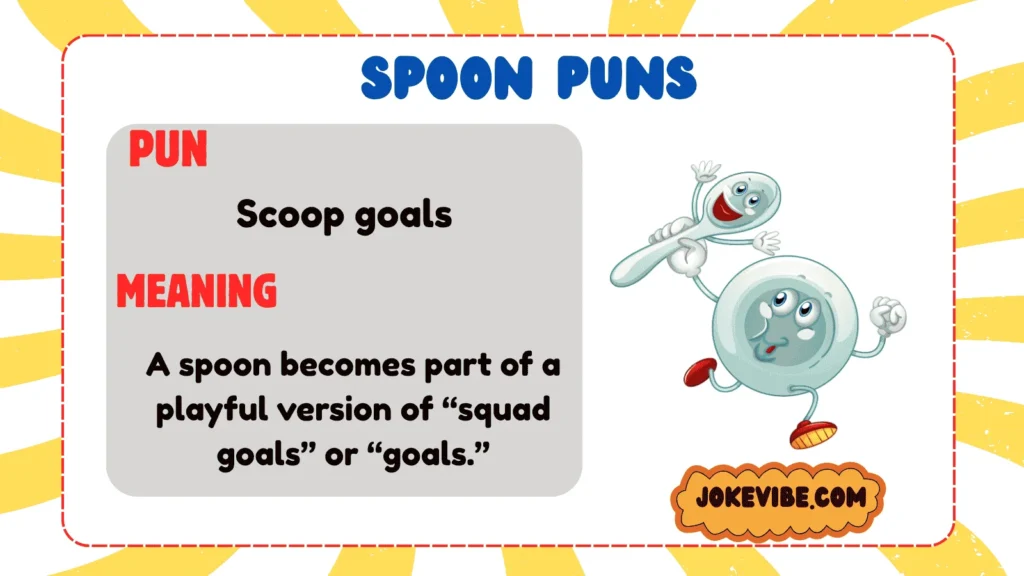
🥄 Pun: “Scoop goals.”
Meaning: A spoon becomes part of a playful version of “squad goals” or “goals.”
Why It’s Funny: The tiny phrase turns scooping into an aspirational lifestyle.
Best Used For: Dessert photos, ice cream posts, and Instagram captions.
🥄 Pun: “Spoon happens.”
Meaning: This is a spoon-themed twist on a familiar phrase about unexpected situations.
Why It’s Funny: The replacement word is completely ordinary, which makes the phrase unexpectedly silly.
Best Used For: Meme captions and casual posts.
🥄 Pun: “Stay calm and stir on.”
Meaning: This transforms a familiar motivational phrase into spoon-related advice.
Why It’s Funny: The spoon suddenly becomes a source of life coaching.
Best Used For: Kitchen signs, food posts, and motivational humor.
🥄 Pun: “Just going with the bowl.”
Meaning: The phrase plays with the idea of “going with the flow” while replacing flow with a bowl.
Why It’s Funny: The sentence sounds almost inspirational but ends somewhere much more ridiculous.
Best Used For: Soup photos, relaxed captions, and food content.
🥄 Pun: “Keep your friends close and your spoons closer.”
Meaning: This turns a familiar saying into a playful statement about utensils.
Why It’s Funny: A spoon is suddenly treated like a treasured possession.
Best Used For: Kitchen humor, memes, and foodie captions.
🥄 Pun: “Currently stirring up good vibes.”
Meaning: “Stirring up” normally describes creating activity, while the spoon literally stirs.
Why It’s Funny: It gives a simple cooking action a cheerful personality.
Best Used For: Instagram, TikTok, cafés, and cooking content.
Spoon Dad Jokes
Spoon dad jokes are supposed to make people laugh and groan at the same time. That is part of their charm.
A dad joke works best when the punchline is obvious enough that you can see it coming but unexpected enough to make you sigh when it arrives. Spoon jokes are perfect for this because the vocabulary is so flexible.
These are intentionally cheesy. If someone rolls their eyes after hearing one, the joke has probably done its job.
🥄 Pun: “Why did the spoon get promoted? It really knew how to handle things.”
Meaning: The spoon’s handle becomes a metaphor for competence.
Why It’s Funny: The promotion sounds serious until you remember the employee is literally a spoon.
Best Used For: Family dinners, dad-joke collections, and kids.
🥄 Pun: “Why was the spoon such a good musician? It knew how to stir up a beat.”
Meaning: Stirring food is combined with making music.
Why It’s Funny: The spoon becomes a kitchen percussionist.
Best Used For: Kids, classroom humor, and music-themed food posts.
🥄 Pun: “What did the spoon say after dessert? ‘That was a sweet scoop.’”
Meaning: The spoon comments on dessert while using “scoop” as the punchline.
Why It’s Funny: The spoon speaks like a food critic despite being the utensil.
Best Used For: Dessert posts and family jokes.
🥄 Pun: “Why did the spoon avoid arguments? It didn’t want to get stirred up.”
Meaning: “Stirred up” can mean emotionally upset while also describing spoon movement.
Why It’s Funny: The spoon has an oddly sensible personality for a piece of silverware.
Best Used For: Family-friendly humor and casual conversations.
🥄 Pun: “Why did the spoon start a business? It wanted to serve a purpose.”
Meaning: Serving is both a practical food-related action and a broader expression about usefulness.
Why It’s Funny: The spoon suddenly becomes an ambitious entrepreneur.
Best Used For: Workplace jokes, kids, and business-themed humor.
🥄 Pun: “What does a spoon do when it needs confidence? It gives itself a little scoop talk.”
Meaning: “Scoop talk” plays on “pep talk.”
Why It’s Funny: The spoon gets motivational coaching in its own strange language.
Best Used For: Kids, motivational memes, and dad-joke fans.
Spoon Food Puns
Food and spoon jokes naturally belong together. Soups, cereals, ice cream, pudding, oatmeal, yogurt, sauces, mashed potatoes, and desserts all create situations where spoon wordplay feels natural.
Food puns are also particularly useful for bloggers and creators because the joke can complement the actual subject of a post. A dessert creator can use a scoop joke. A soup recipe can use stirring humor. A breakfast post can play with cereal and spoon language.
The best food puns don’t distract from the meal. They add personality to it.
🥄 Pun: “This soup is giving me something to stir about.”
Meaning: The phrase suggests the soup is worth thinking about while referencing stirring.
Why It’s Funny: A simple bowl of soup is treated like a serious topic of discussion.
Best Used For: Soup recipes, food blogs, and restaurant captions.
🥄 Pun: “I came for the dessert and stayed for the scoop.”
Meaning: The “scoop” refers both to dessert served by spoon and getting interesting information.
Why It’s Funny: It gives a dessert a little bit of gossip-column energy.
Best Used For: Ice cream shops, dessert posts, and playful captions.
🥄 Pun: “Oatmeal and I have a very spoon-to-spoon relationship.”
Meaning: This twists the idea of a close personal connection into a spoon-based phrase.
Why It’s Funny: The relationship is between a person, oatmeal, and a utensil.
Best Used For: Breakfast captions and food blogs.
🥄 Pun: “Pudding makes every spoonful feel like a tiny celebration.”
Meaning: The joke treats each spoonful as something worth celebrating.
Why It’s Funny: The humor comes from exaggerating a very ordinary dessert moment.
Best Used For: Dessert captions, family posts, and recipe content.
🥄 Pun: “My yogurt and spoon have a smooth working relationship.”
Meaning: “Smooth” describes yogurt while also suggesting that the two work together perfectly.
Why It’s Funny: The spoon gets treated like a professional coworker.
Best Used For: Breakfast posts, wellness content, and food photography.
🥄 Pun: “Ice cream is proof that life gets better by the scoop.”
Meaning: The phrase turns scooping ice cream into a positive life philosophy.
Why It’s Funny: It sounds like serious advice but is ultimately an excuse to eat more dessert.
Best Used For: Ice cream captions, summer posts, and dessert marketing.
Spoon Love Puns and Romantic Messages
Love puns work when the wordplay supports the feeling instead of replacing it. A spoon is actually a useful romantic symbol because it suggests comfort, closeness, sharing, and everyday moments.
You don’t need a huge declaration of love to make a message memorable. A short line on a note beside breakfast can sometimes be more charming than a dramatic paragraph.
These spoon love puns are designed to be affectionate without becoming overly sentimental.
🥄 Pun: “You make my heart stir in all the right ways.”
Meaning: The phrase combines emotional excitement with the physical action of stirring.
Why It’s Funny: The kitchen reference gives a romantic sentence a playful twist.
Best Used For: Valentine’s Day, anniversaries, and romantic texts.
🥄 Pun: “I’m totally spoon over heels for you.”
Meaning: This combines spoon imagery with the phrase “head over heels.”
Why It’s Funny: The familiar romantic expression gets turned into ridiculous utensil wordplay.
Best Used For: Flirty texts, cards, and social captions.
🥄 Pun: “You’re the one I’d share my last spoonful with.”
Meaning: Sharing the final bite suggests affection and generosity.
Why It’s Funny: The romance is exaggerated around something as small as a spoonful of food.
Best Used For: Couples, anniversary cards, and cute messages.
🥄 Pun: “Our love has a good handle on forever.”
Meaning: “Handle” connects the spoon to the idea of managing something successfully.
Why It’s Funny: The spoon reference is subtle enough to keep the romantic message intact.
Best Used For: Anniversary cards and wedding messages.
🥄 Pun: “You’re simply soup-er important to me.”
Meaning: “Soup-er” replaces “super” with a soup reference.
Why It’s Funny: It combines a familiar affectionate phrase with spoon-friendly food.
Best Used For: Cute texts, couples, and food-themed cards.
🥄 Pun: “Every meal is better when I have you to spoon with.”
Meaning: The line combines sharing meals with the affectionate idea of being close.
Why It’s Funny: It gives an ordinary eating situation a romantic twist.
Best Used For: Couples, date-night captions, and anniversary posts.
Spoon Birthday Puns and Greeting Card Messages
Birthday cards are one of the easiest places to use spoon puns because the message can be short, cheerful, and personal. A food-themed birthday joke can make a generic card feel customized.
The trick is to connect the spoon joke to celebration rather than forcing the utensil reference into every sentence. Birthday humor works best when the pun is the little surprise inside an otherwise warm message.
These examples can work on cards, gift tags, social posts, party invitations, or birthday texts.
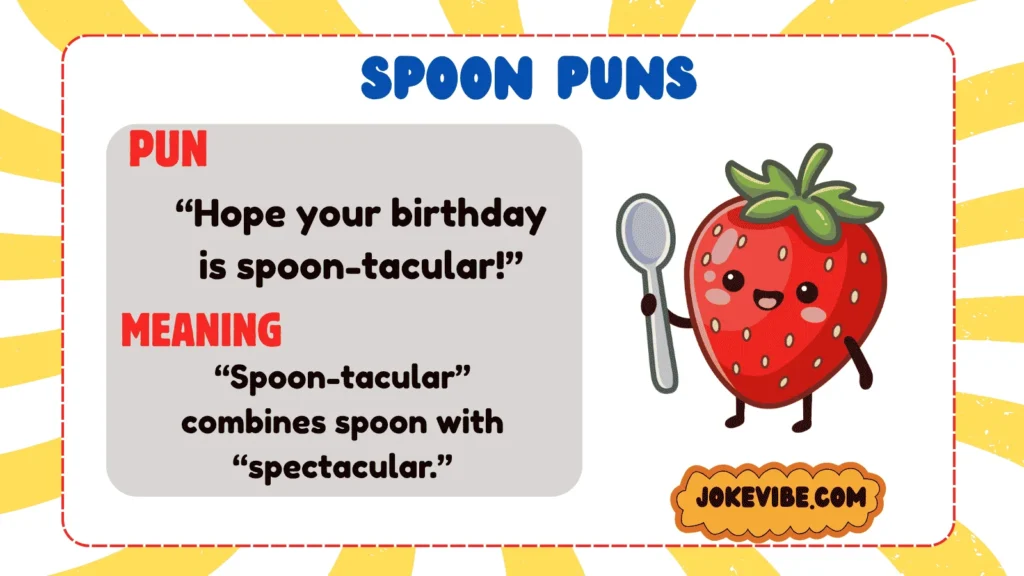
🥄 Pun: “Hope your birthday is spoon-tacular!”
Meaning: “Spoon-tacular” combines spoon with “spectacular.”
Why It’s Funny: The familiar celebration word gets a silly utensil makeover.
Best Used For: Birthday cards, party captions, and kids’ birthdays.
🥄 Pun: “Have a scoop-tastic birthday!”
Meaning: “Scoop-tastic” combines scoop with “fantastic.”
Why It’s Funny: It sounds like a legitimate celebration word despite being completely made up.
Best Used For: Ice cream parties, birthday cards, and social posts.
🥄 Pun: “Wishing you a birthday with plenty of sweet moments to spoon over.”
Meaning: The line plays with “spoon over” as though happy moments are something you can serve.
Why It’s Funny: It creates an unusual image while keeping the birthday sentiment positive.
Best Used For: Adult birthday cards and social captions.
🥄 Pun: “Another year older, but still handling life like a pro.”
Meaning: “Handling” connects personal competence with the handle of a spoon.
Why It’s Funny: The spoon connection is hidden inside a normal compliment.
Best Used For: Adult birthday cards and workplace messages.
🥄 Pun: “May your birthday be filled with good food, great friends, and one seriously reliable spoon.”
Meaning: The message treats the spoon as an essential part of a successful birthday.
Why It’s Funny: The utensil receives the same importance as friends and food.
Best Used For: Foodies, dinner parties, and funny birthday cards.
🥄 Pun: “You deserve the biggest slice, the sweetest dessert, and the fanciest spoon.”
Meaning: The message exaggerates the importance of the spoon as part of the celebration.
Why It’s Funny: A fancy utensil becomes a birthday luxury.
Best Used For: Family cards, foodie friends, and birthday captions.
Spoon Puns for Teachers and Kids
Classroom humor needs to be simple, clean, and easy to understand. Spoon puns are a good fit because they connect to familiar objects and don’t require complicated cultural references.
Teachers can use spoon jokes on classroom signs, lunchroom activities, food-themed lessons, reward cards, bulletin boards, or writing prompts. Parents can also use them in lunchbox notes.
For kids, the best jokes are usually the ones they can repeat themselves. If a child can understand the wordplay and tell the joke to someone else, it has passed the classroom test.
🥄 Pun: “You’re doing a spoon-tacular job!”
Meaning: “Spoon-tacular” is a playful version of “spectacular.”
Why It’s Funny: It turns praise into a silly spoon-themed word.
Best Used For: Teacher praise, classroom notes, and reward stickers.
🥄 Pun: “Keep stirring up great ideas.”
Meaning: Stirring becomes a metaphor for generating ideas.
Why It’s Funny: A cooking action becomes creative advice.
Best Used For: Writing classes, art classes, and motivational boards.
🥄 Pun: “You really have a handle on this lesson.”
Meaning: “Have a handle on something” means understand it well.
Why It’s Funny: The phrase works normally while secretly referencing a spoon.
Best Used For: Teachers, homework feedback, and classroom encouragement.
🥄 Pun: “Don’t be afraid to scoop up new knowledge.”
Meaning: The spoon action becomes a metaphor for collecting information.
Why It’s Funny: Learning is treated like something you can literally scoop.
Best Used For: Elementary classrooms and educational posts.
🥄 Pun: “Great ideas are always worth a spoonful of attention.”
Meaning: The phrase compares attention to a spoonful of something valuable.
Why It’s Funny: It gives an ordinary amount of food a serious academic role.
Best Used For: Classroom posters and writing prompts.
🥄 Pun: “You’re serving up some excellent answers today.”
Meaning: “Serving up” connects food service with providing good answers.
Why It’s Funny: Students become chefs serving knowledge instead of food.
Best Used For: Teachers, classroom humor, and school social media.
Spoon Puns for Instagram, TikTok, and Facebook
Social media humor has one major requirement: the joke needs to work quickly. A caption should complement the photo or video rather than compete with it.
Spoon puns are especially useful for food creators because they can be connected to the visual content. A dessert photo can use a scoop joke. A soup video can use stirring wordplay. A kitchen reel can use a handle joke.
For TikTok, short phrases work well as on-screen text. For Instagram, a slightly more polished caption can create personality. Facebook allows room for a joke followed by a short story.
🥄 Pun: “Serving looks and spoonfuls.”
Meaning: “Serving looks” is a social phrase, while spoonfuls refer to food.
Why It’s Funny: It connects fashion-style language with eating.
Best Used For: Instagram food photos and lifestyle posts.
🥄 Pun: “This meal has me stirring with excitement.”
Meaning: “Stirring with excitement” resembles an emotional expression while referencing the spoon.
Why It’s Funny: The cooking action becomes an exaggerated emotional reaction.
Best Used For: Recipe reels and food photography.
🥄 Pun: “Scoop, there it is.”
Meaning: This uses “scoop” as a playful replacement in a familiar rhythmic phrase.
Why It’s Funny: The short setup makes the punchline instantly recognizable.
Best Used For: Ice cream videos, dessert reels, and TikTok captions.
🥄 Pun: “A little spoonful of happiness.”
Meaning: The spoon becomes a measurement for joy.
Why It’s Funny: It turns a tiny serving into something emotionally significant.
Best Used For: Dessert photos and wholesome Instagram posts.
🥄 Pun: “Current mood: stirring things up.”
Meaning: “Stirring things up” means creating activity while also describing what a spoon does.
Why It’s Funny: It gives the spoon an energetic personality.
Best Used For: TikTok, Instagram Stories, and cooking videos.
🥄 Pun: “Just out here making every bowl count.”
Meaning: The phrase gives a bowl and its spoon an exaggerated sense of importance.
Why It’s Funny: A simple meal becomes a meaningful mission.
Best Used For: Soup posts, meal-prep content, and food blogs.
Spoon Puns for Marketing, Food Blogs, and Content Creators
Puns can be powerful marketing tools when they fit the brand. They are particularly useful for restaurants, cafés, bakeries, dessert shops, recipe websites, kitchen brands, food influencers, and cooking newsletters.
The important thing is relevance. A spoon pun should reinforce the product or message rather than appear simply because the writer wanted to include a joke.
For bloggers, a pun can also make an introduction or subheading more memorable. For brands, a short spoon joke can make a social post feel less like an advertisement.
🥄 Pun: “We’re serving up something worth talking about.”
Meaning: “Serving up” works both as a food phrase and as a way to introduce an idea.
Why It’s Funny: It creates a natural bridge between the product and the message.
Best Used For: Restaurant marketing and food launches.
🥄 Pun: “Spoon your way to something delicious.”
Meaning: The spoon becomes the imagined vehicle for enjoying food.
Why It’s Funny: It gives the customer a playful action to visualize.
Best Used For: Dessert brands and cafés.
🥄 Pun: “A recipe worth stirring about.”
Meaning: This combines “worth talking about” with the action of stirring.
Why It’s Funny: It sounds like a normal endorsement while quietly becoming kitchen wordplay.
Best Used For: Food blogs and recipe newsletters.
🥄 Pun: “Good food starts with the right scoop.”
Meaning: A scoop can refer to the action of serving food and to getting the right amount.
Why It’s Funny: The phrase sounds like practical culinary advice while working as a promotional line.
Best Used For: Dessert shops and recipe creators.
🥄 Pun: “We’ve got a handle on great taste.”
Meaning: “Have a handle on” means understanding something well, while a spoon has a handle.
Why It’s Funny: The phrase naturally combines confidence with a kitchen reference.
Best Used For: Kitchen brands, restaurants, and food companies.
🥄 Pun: “Stirring up your next favorite meal.”
Meaning: The phrase suggests both cooking and creating excitement around a meal.
Why It’s Funny: The same verb works in both the culinary and promotional contexts.
Best Used For: Recipe websites, meal services, and cooking campaigns.
How to Use Spoon Puns
A good spoon pun becomes more effective when it matches the situation. The same joke that works beautifully on an Instagram dessert photo might sound strange in a birthday card.
Before using a pun, think about who will read it, what they are looking at, and what emotion you want to create.
For social media, shorter is usually better. A spoon pun can sit directly on a food photo or appear as the first line of a caption.
For greeting cards, combine the pun with a sincere message. The joke should add personality rather than replace the sentiment.
For blogs, use spoon wordplay as an introduction, section title, caption, or closing line. Avoid stuffing puns into every paragraph.
For conversations, timing matters more than complexity. A simple spoon joke delivered at the right moment can be funnier than an elaborate pun that requires an explanation.
A useful rule is:
Use the pun as seasoning, not the entire meal.
One strong joke can make a message memorable. Ten unrelated jokes can make it feel crowded.
Where to Use Spoon Puns
Social Media
Spoon puns are ideal for food photos, cooking reels, dessert videos, restaurant announcements, and kitchen-themed posts. Short lines work particularly well when the image already tells most of the story.
Try pairing a spoon pun with a photo of soup, ice cream, breakfast, coffee, oatmeal, or dessert. A concise caption such as “A little spoonful of happiness” can support the visual without overwhelming it.
TikTok
TikTok captions and on-screen text should be quick to read. Spoon wordplay can work especially well during cooking, baking, meal-prep, and restaurant videos.
Facebook gives you more room to tell a small story. Start with a spoon pun, then add a personal observation or food-related anecdote.
Greeting Cards
Spoon jokes are useful for birthdays, anniversaries, thank-you cards, friendship cards, Valentine’s Day, and food-themed gifts. Add a heartfelt sentence after the pun to make the message feel personal.
Birthday Cards
Use spoon and scoop language with cake, ice cream, desserts, or dinner references. The joke can make an ordinary birthday greeting feel customized.
Marketing
Restaurants, bakeries, cafés, cooking brands, dessert shops, and food creators can use spoon puns to add personality to promotions. Keep the joke relevant to the product.
Teachers
Clean spoon puns can work on classroom boards, reward notes, lunchroom activities, writing prompts, and educational social posts.
Blogs
Food bloggers can use spoon puns in introductions, recipe descriptions, headings, captions, newsletters, and social promotion. Just make sure the humor supports the topic.
Conversation
A spoon pun can be a quick icebreaker at dinner or a playful response when someone is eating soup or dessert. The best conversational puns are short enough to say naturally.
How to Create Your Own Spoon Puns
Creating original spoon puns is easier when you stop trying to “invent a joke” and start looking for two meanings that can overlap.
Begin with spoon vocabulary.
Think about:
- Spoon
- Spoonful
- Scoop
- Stir
- Handle
- Bowl
- Serve
- Serving
- Silverware
- Taste
- Bite
- Table
- Dish
- Ladle
- Kitchen
- Recipe
- Meal
- Dessert
Next, make a second list of common expressions.
For example:
- Handle it
- Stir things up
- Have good taste
- Serve a purpose
- Go with the flow
- Take sides
- A spoonful of something
- Worth talking about
- Get the scoop
- Have a lot on your plate
Now connect the two lists.
“Have a handle on it” can become a spoon joke because a spoon literally has a handle.
“Get the scoop” already has a spoon connection because a scoop can mean both information and a serving action.
“Stir things up” is another natural connection because stirring is literally something a spoon does.
The final step is editing.
Ask yourself:
Does the sentence sound natural before the pun appears?
If the answer is yes, the joke has a better chance of landing.
Tips for Writing Better Spoon Puns
Keep the setup simple. The reader should understand the situation immediately.
Use familiar phrases. Common expressions give the reader something recognizable to connect with.
Don’t explain too much. A pun should ideally make sense on its own.
Choose one main twist. Adding three different wordplays to one sentence can weaken all of them.
Read the joke aloud. Some puns look clever on paper but sound awkward when spoken.
Match the audience. A classroom joke should be cleaner and simpler than a joke intended for adult social media.
Make the wording natural. If you have to force the word “spoon” into a sentence, look for another approach.
Use context. A spoon joke becomes stronger when the reader can see a spoon, bowl, dessert, or meal.
Don’t overuse puns. Even excellent wordplay becomes tiring if every sentence contains one.
Edit for rhythm. A good punchline often sounds better when unnecessary words are removed.
Common Mistakes When Writing Spoon Puns
One common mistake is choosing a spoon-related word simply because it exists. Not every sentence containing “spoon” becomes a pun.
Another mistake is relying on the same handful of expressions. “Stir things up” and “have a handle on it” are useful, but repeating them throughout an article quickly makes the humor predictable.
Weak puns also tend to explain themselves too heavily. If the joke needs a paragraph of explanation, the underlying wordplay probably needs another edit.
Another issue is forcing the pun to fit the keyword. SEO content should still sound like something a real person would enjoy reading. Search engines may understand topic relevance, but readers decide whether the content is genuinely useful and entertaining.
Avoid stuffing “spoon puns” into every heading and paragraph. Natural semantic coverage is stronger. Terms such as silverware, utensils, soup, bowls, scooping, stirring, cooking, desserts, recipes, food, captions, jokes, wordplay, and humor provide useful topical context without repetitive keyword use.
Finally, don’t confuse quantity with quality. Six memorable jokes are more valuable than thirty weak variations of the same punchline.
Spoon Puns for Different Audiences
For kids, focus on simple words and obvious visual humor. Scooping, stirring, bowls, and desserts are easy concepts to understand.
For friends, you can be more sarcastic and conversational. Use spoon puns as quick reactions rather than formal jokes.
For couples, spoon puns can become affectionate. Words such as “share,” “taste,” “stir,” and “spoonful” naturally support romantic messages.
For teachers, keep the humor clean and encouraging. A spoon pun can be used as praise or a classroom writing prompt.
For food bloggers, connect the joke to the actual recipe. A spoon pun should enhance the food experience.
For businesses, make the joke support the brand voice. A playful café can be more pun-heavy than a luxury restaurant.
For content creators, consider where the joke will appear. A TikTok overlay needs fewer words than a blog introduction.
Spoon Pun Ideas for Captions
If you need something extremely short, these quick lines can work as starting points for your own captions:
- Spoonfuls of happiness.
- Stirring up something good.
- Scoop happens.
- Handle with deliciousness.
- Serving good vibes.
- Stay spoon-tastic.
- One scoop at a time.
- In my stirring era.
- Bowl goals achieved.
- A taste worth talking about.
- Scoop dreams into reality.
- Life tastes better with a spoon.
These are especially easy to customize around the actual photo or video. Adding a specific detail often makes a generic caption feel much more original.
Spoon Puns for Foodies
Food lovers tend to appreciate puns that celebrate the eating experience itself. Instead of making the spoon the entire joke, use it as a bridge between the food and the humor.
A spoonful of soup can become a “warm hug with a handle.” A dessert scoop can become “a little happiness with a serving size.” Even a bowl of cereal can become a morning ritual worth spooning about.
The best foodie humor feels connected to the meal. If you’re posting a rich chocolate dessert, use chocolate vocabulary. If you’re posting soup, lean into stirring and warmth. If you’re sharing breakfast, play with cereal, oatmeal, yogurt, or coffee.
That context makes the pun feel written specifically for the content instead of pulled from a generic joke list.
Internal Link Suggestions for a Spoon Puns Article
For stronger topical coverage and a better internal linking structure, consider linking this article to related humor pages such as:
- Banana Puns
- Orange Puns
- Food Puns
- Dessert Puns
- Cooking Puns
- Kitchen Puns
- Ice Cream Puns
- Soup Puns
- Breakfast Puns
- Dad Jokes
- Funny Captions
- Cute Love Puns
- Birthday Puns
- Teacher Puns
Use descriptive anchor text that naturally tells readers what they will find on the linked page.
FAQs
What are spoon puns?
Spoon puns are jokes and playful phrases that use spoon-related words such as stir, scoop, handle, bowl, and spoonful to create humorous double meanings.
What is a funny spoon pun?
A funny spoon pun is a short joke that connects spoon-related language with a familiar phrase. For example, “I’ve really got a handle on breakfast” uses the spoon’s handle as a twist on a common expression.
What are good spoon puns for Instagram?
Short lines such as “Stirring up good vibes,” “Scoop goals,” and “A little spoonful of happiness” work well for Instagram because they are quick to read and pair naturally with food photos.
Can I use spoon puns in birthday cards?
Yes. Spoon puns work well in birthday cards, especially when the celebration includes cake, ice cream, dinner, or another food theme. Pair the pun with a sincere birthday wish.
Are spoon puns suitable for kids?
Yes. Spoon puns can be very kid-friendly when they focus on simple concepts such as scooping, stirring, bowls, desserts, and meals.
How do you make a good spoon pun?
Start with spoon-related words, find common phrases that contain similar meanings, and combine them naturally. The strongest puns usually create a quick double meaning without requiring a long explanation.
What words work well with spoon puns?
Useful words include scoop, stir, handle, bowl, serve, serving, taste, spoonful, silverware, dish, bite, and table. Common expressions containing these ideas can become strong starting points.
Where can I use spoon puns?
You can use them in Instagram captions, TikTok videos, Facebook posts, greeting cards, birthday messages, classroom activities, food blogs, restaurant marketing, texts, conversations, and newsletters.
Final Thoughts
Spoon puns prove that good humor doesn’t always need a complicated subject. Sometimes an ordinary kitchen utensil is enough to create a surprisingly large serving of wordplay.
The best spoon puns work because they connect familiar language with something physical and recognizable. Words such as stir, scoop, handle, bowl, and serve already have multiple meanings, which gives writers plenty of room to play.
That makes spoon humor useful far beyond a dinner-table joke. You can turn a spoon pun into an Instagram caption, a TikTok overlay, a birthday message, a classroom joke, a food-blog introduction, a restaurant promotion, or a silly text to a friend.
If you’re writing your own jokes, remember that originality matters more than quantity. Start with a common phrase, find a spoon-related word that naturally fits, and then edit the sentence until the punchline feels effortless. Don’t force the wordplay just to make it sound like a pun.

I’m Naqash Ayub, and I believe a great pun can make any day better. At Jokevibe, I create original wordplay, witty jokes, and fun content that’s simple to read, easy to share, and guaranteed to bring a smile.


