Pencil puns are a simple way to turn an ordinary writing tool into a source of clever laughs. Whether you need a funny caption, a classroom joke, a birthday-card message, or a quick one-liner for a friend, pencils give you plenty of material to work with. After all, they come with points, leads, erasers, sharpeners, wood, graphite, and enough wordplay to keep your humor from going dull.
Updated for 2026, this collection brings together original pencil jokes, clever one-liners, cute sayings, school-friendly humor, and social media-ready captions. You’ll find ideas for Instagram, TikTok, Facebook, birthday cards, greeting cards, teachers, students, friends, family, everyday conversations, marketing, and blogging.
People love pencil humor because it is easy to understand and surprisingly flexible. A pencil can be sharp, blunt, sketchy, pointless, well-rounded, or completely erased—which gives you a whole toolbox of comic possibilities.
So sharpen your sense of humor and get comfortable. These pencil puns are about to make your day a little more write-worthy.
Quick Answer: What Are Pencil Puns?
Pencil puns are jokes and wordplay built around pencils, writing, drawing, erasers, sharpeners, graphite, and related ideas. They often twist words such as point, lead, sharp, draw, write, sketch, erase, and pencil into humorous meanings. They work especially well for school jokes, captions, cards, classroom humor, and quick conversation.
What’s Inside
| Section | What You’ll Find |
|---|---|
| Funny Pencil Puns | Everyday jokes for instant laughs |
| Clever Pencil Puns | Smart wordplay for writers and word lovers |
| Cute Pencil Puns | Sweet lines for cards and messages |
| Pencil One-Liners | Short jokes for quick laughs |
| Pencil Dad Jokes | Classic groan-worthy humor |
| Pencil Instagram Captions | Short, shareable social posts |
| School Pencil Puns | Student and teacher-friendly jokes |
| Pencil Love Puns | Romantic and playful lines |
| Pencil Birthday Puns | Birthday cards and messages |
| Pencil Drawing Puns | Art, sketching, and creative humor |
| Pencil Pick-Up Lines | Playful conversation starters |
| Pencil Puns for Kids | Simple, clean classroom humor |
| How to Create Pencil Puns | A practical wordplay guide |
| Where to Use Them | Social media, cards, blogs, and more |
| FAQs | Quick answers to common questions |
What Are Pencil Puns?
Pencil puns are jokes that use the language surrounding pencils to create a second meaning. The magic usually comes from words that already have multiple meanings.
Take the word point. A pencil has a point, but you can also make a point in an argument. Suddenly, something sitting in a pencil case becomes the setup for a joke.
The same thing happens with sharp. A pencil can be sharp enough to write clearly, while a person can be sharp because they are clever. Lead can refer to the material inside a pencil, but it can also mean being in front. Draw can describe using a pencil to make a picture, but it can also mean attracting attention.
That flexibility makes pencil humor surprisingly rich.
Pencil puns also work because almost everyone has used a pencil. Students write with them. Artists sketch with them. Teachers keep them around. Office workers use them for notes. Parents find them under couches. Writers lose them five minutes after buying a new pack.
In other words, pencils are ordinary enough to be relatable and versatile enough to support plenty of wordplay.
Here are a few examples:
- “I have a point, but I promise not to argue.”
- “That pencil is looking sharp today.”
- “My pencil has a bright future ahead of it.”
- “I tried to draw a conclusion, but my pencil wandered.”
- “Never underestimate a pencil—it has a lot of leadership potential.”
The best pencil jokes don’t simply mention a pencil. They connect pencil vocabulary to something unexpected. That’s what turns a basic object into a punchline.
Why Are Pencil Puns So Popular?
Pencil puns are popular because they are familiar, flexible, and easy to understand. You don’t need a complicated backstory to get the joke. If you’ve ever sharpened a pencil, erased a mistake, or watched the tip disappear while writing, you already understand the setup.
In real conversations, people usually use puns like these when they want a quick laugh without making the moment too serious. A teacher might make a pencil joke before a test. A student might use one as an Instagram caption. A parent might write one inside a school-themed birthday card.
From a humor-writing perspective, pencils are especially useful because their vocabulary naturally contains words with comic potential. Point, lead, sharp, dull, erase, draw, sketch, write, color, line, and break can all carry double meanings.
There is also something charming about pencil humor. It feels harmless and playful. That makes it useful for classrooms, family conversations, office banter, greeting cards, and children’s content.
A good pencil pun can also be short. You don’t need three paragraphs to set one up.
Sometimes all you need is:
“I wanted to make a sharp joke, but my pencil wasn’t ready.”
That simplicity is part of the appeal. Pencil puns don’t demand much from the reader. They simply offer a tiny twist and invite a smile.
Best Funny Pencil Puns
Funny pencil puns work best when the setup is familiar and the punchline takes a small unexpected turn. These jokes are designed for everyday conversations, classroom laughs, texts, cards, and casual social posts.
The goal isn’t to force every pencil-related word into a joke. Good wordplay feels natural. A strong punchline should make the reader think, “Oh, I see what you did there.”
These lines lean into the everyday struggles of pencils: getting dull, disappearing, breaking, being erased, and somehow never being where you left them.
✏️ “This pencil has a point, and it’s making itself known.”
Meaning: The joke treats the physical point of a pencil like a person confidently making an argument.
Why It’s Funny: “Making a point” has both a writing-related and argumentative meaning.
Best Used For: Classroom humor, captions, and conversations.
✏️ “I’m trying to stay positive, but my pencil keeps getting negative.”
Meaning: The pencil’s graphite becomes a playful excuse for talking about positive and negative attitudes.
Why It’s Funny: It turns an ordinary pencil into someone with an emotional outlook.
Best Used For: Social media captions and school jokes.
✏️ “My pencil broke up with me. It said I was too much pressure.”
Meaning: The pencil snapping under pressure is treated like a relationship problem.
Why It’s Funny: “Pressure” works literally for a pencil and emotionally for a relationship.
Best Used For: Text messages, friends, and funny posts.
✏️ “I sharpened my pencil, but apparently my personality still needs work.”
Meaning: The joke compares improving a pencil’s point with improving someone’s personality.
Why It’s Funny: A pencil can be sharpened instantly; people usually take considerably longer.
Best Used For: Self-deprecating captions.
✏️ “My pencil has been through a lot. You could say it has a colorful past.”
Meaning: A used pencil may have drawn many things, giving it a metaphorical “past.”
Why It’s Funny: “Colorful past” normally describes an interesting life, but here it refers to drawings.
Best Used For: Art jokes and conversations.
✏️ “I lost my pencil again. At this point, it’s leading a separate life.”
Meaning: The pencil keeps disappearing as though it has its own independent existence.
Why It’s Funny: “Leading” hints at pencil lead while pretending the pencil is living independently.
Best Used For: Students, writers, and office humor.
✏️ “I wanted a dull day, but my pencil had other plans.”
Meaning: A dull pencil is contrasted with a dull or boring day.
Why It’s Funny: The same word describes both a lack of excitement and a worn pencil tip.
Best Used For: Instagram captions and everyday jokes.
Clever Pencil Puns
Clever pencil puns are a little more subtle. Instead of simply saying something is “sharp,” they use the language of writing, drawing, and stationery to create a second layer of meaning.
These are particularly useful for writers, bloggers, teachers, artists, and anyone who enjoys wordplay that makes people pause for half a second before laughing.
A clever pun doesn’t have to be complicated. In fact, the strongest ones are often built around a familiar phrase that gets redirected toward pencils.
Think of these as the pencil equivalent of a raised eyebrow: smart enough to notice, simple enough to enjoy.
✏️ “I refuse to argue with a pencil. It always has a point.”
Meaning: The pencil’s physical point becomes a metaphor for having a strong argument.
Why It’s Funny: The sentence works as both a joke about pencils and a joke about stubborn people.
Best Used For: Conversations and clever captions.
✏️ “A pencil’s greatest strength is knowing when to draw the line.”
Meaning: A pencil literally draws lines, while “draw the line” means setting a boundary.
Why It’s Funny: The phrase already has a figurative meaning, making the pencil connection feel natural.
Best Used For: Social posts and writer humor.
✏️ “I gave my pencil a leadership role. It already had the lead.”
Meaning: “Lead” refers to pencil material while also describing someone who is ahead or in charge.
Why It’s Funny: One tiny word carries the entire joke.
Best Used For: Office humor, teachers, and captions.
✏️ “My pencil is remarkably grounded. It always comes back down to earth.”
Meaning: The pencil is described as humble while being connected to its wooden material.
Why It’s Funny: The language sounds philosophical before turning into stationery wordplay.
Best Used For: Clever posts and conversations.
✏️ “Every great sketch starts with a line that knows where it’s going.”
Meaning: A drawing begins with lines, while the sentence treats the line as purposeful.
Why It’s Funny: It blends creative advice with personification.
Best Used For: Artist captions and blogs.
✏️ “My pencil has excellent boundaries. It knows exactly where to draw the line.”
Meaning: The pencil literally draws lines, while the phrase refers to personal boundaries.
Why It’s Funny: The serious language of boundaries gets a stationery twist.
Best Used For: Instagram, Facebook, and teacher humor.
✏️ “The pencil joined the debate because it wanted to make a point.”
Meaning: The pencil’s point becomes the reason it participates in an argument.
Why It’s Funny: “Make a point” connects everyday conversation with the physical tip of a pencil.
Best Used For: Classroom jokes and writing-related content.
Cute Pencil Puns
Cute pencil puns are ideal when you want something playful rather than laugh-out-loud funny. They work especially well in greeting cards, classroom notes, handmade crafts, school supplies, teacher gifts, and social media posts.
The trick with cute wordplay is to keep the language warm. Instead of relying on a complicated punchline, these jokes turn pencils into friendly little characters.
A pencil can be encouraging. It can be dependable. It can help you fix mistakes. It can even become a tiny metaphor for friendship.
These lines are intentionally wholesome, making them suitable for children, students, teachers, parents, and family members.
✏️ “You make every day a little more write-worthy.”
Meaning: The phrase “write-worthy” turns writing into a compliment.
Why It’s Funny: It gives a pencil-related twist to the idea of having a memorable day.
Best Used For: Friendship cards and teacher notes.
✏️ “You’re the sharpest friend in my pencil case.”
Meaning: A friend is compared to the sharpest pencil.
Why It’s Funny: “Sharp” can mean physically pointed or mentally clever.
Best Used For: Friendship cards and school messages.
✏️ “You and me? We make a pretty good sketch.”
Meaning: The relationship is compared to a drawing.
Why It’s Funny: It turns “sketch” into a playful description of two people together.
Best Used For: Cute friendship captions.
✏️ “Thanks for always helping me erase the rough drafts.”
Meaning: A friend who helps through mistakes is compared to an eraser.
Why It’s Funny: It transforms emotional support into pencil stationery language.
Best Used For: Thank-you cards.
✏️ “You’re the graphite to my good ideas.”
Meaning: Graphite is associated with pencils, while the phrase suggests someone helps ideas come to life.
Why It’s Funny: The technical pencil reference becomes a sweet compliment.
Best Used For: Creative friends and writers.
✏️ “Our friendship has no dull moments.”
Meaning: The phrase compares an exciting friendship with a sharp pencil.
Why It’s Funny: “Dull” describes both boring experiences and worn pencil tips.
Best Used For: Friendship captions.
✏️ “You bring the point to every good story.”
Meaning: Someone adds meaning and purpose to stories.
Why It’s Funny: “Point” connects storytelling with pencil terminology.
Best Used For: Writer friends, teachers, and cards.
Pencil One-Liners
Pencil one-liners are perfect when you need something fast. They work in texts, captions, classroom slides, jokes of the day, social media posts, and casual conversations.
Because one-liners have almost no room for explanation, the punchline has to arrive quickly. The lines below use familiar pencil vocabulary and everyday expressions to create compact jokes.
They can also be used as building blocks. Take a one-liner and add a photo of a pencil, a sketch, a notebook, or a school desk, and you suddenly have an easy social post.
✏️ “My pencil has a point, but I’m still working on mine.”
Meaning: The physical pencil point is compared with having a purpose.
Why It’s Funny: The joke shifts from stationery to personal direction.
Best Used For: Self-deprecating captions.
✏️ “Stay sharp. Life has enough dull moments.”
Meaning: Being sharp is treated as a positive personality trait.
Why It’s Funny: “Dull” works for both pencils and boring experiences.
Best Used For: Motivational posts.
✏️ “I’m drawing a blank, but at least I have the pencil.”
Meaning: “Drawing a blank” means having no ideas, while drawing normally requires a pencil.
Why It’s Funny: The literal object is present even though the idea is missing.
Best Used For: Writer humor.
✏️ “Never underestimate a pencil with a fresh point.”
Meaning: A newly sharpened pencil is treated as surprisingly powerful.
Why It’s Funny: It gives a humble stationery item an exaggerated sense of importance.
Best Used For: School and office captions.
✏️ “My pencil and I have one thing in common: we both need a break.”
Meaning: A pencil can break, while a person can need rest.
Why It’s Funny: “Break” has two completely different meanings.
Best Used For: Work or study posts.
✏️ “I’m taking life one pencil stroke at a time.”
Meaning: The phrase turns slow progress into a drawing metaphor.
Why It’s Funny: It sounds like serious life advice until the pencil appears.
Best Used For: Artistic captions.
✏️ “When life gets sketchy, grab a pencil.”
Meaning: “Sketchy” can mean uncertain or suspicious, while a pencil creates sketches.
Why It’s Funny: The solution to a figurative problem is a literal drawing tool.
Best Used For: Instagram and creative posts.
Pencil Dad Jokes
Pencil dad jokes should make you smile first and groan immediately afterward. That’s the entire point.
The best dad jokes are simple, clean, predictable, and just clever enough to make someone say, “Okay, that was actually pretty good.”
Pencils are excellent material for this style because their vocabulary is packed with double meanings. A pencil can be sharp, dull, broken, erased, drawn, colored, pointed, or full of lead.
That gives dad-joke writers plenty of ammunition without needing complicated setups.
✏️ “Why did the pencil get promoted? It always had the lead.”
Meaning: The pencil’s lead becomes a metaphor for being a leader.
Why It’s Funny: The answer sounds like workplace logic but is really stationery wordplay.
Best Used For: Classic dad-joke moments.
✏️ “Why did the pencil go to school? It wanted to get a little sharper.”
Meaning: The pencil goes to school to become “sharper.”
Why It’s Funny: People become smarter through education, while pencils become sharper through sharpening.
Best Used For: Kids and classroom humor.
✏️ “Why was the pencil calm during the test? It knew how to stay on point.”
Meaning: Staying focused is combined with the pencil’s point.
Why It’s Funny: The phrase works as both test advice and pencil terminology.
Best Used For: Teachers and students.
✏️ “What did the pencil say after making a mistake? ‘Let’s erase that thought.’”
Meaning: Erasing a pencil mark becomes a way to erase a thought.
Why It’s Funny: It treats a simple correction like a dramatic emotional decision.
Best Used For: Family and classroom jokes.
✏️ “Why did the pencil refuse to gossip? It didn’t want to draw conclusions.”
Meaning: Drawing is connected with the phrase “draw conclusions.”
Why It’s Funny: The pencil gets portrayed as morally responsible.
Best Used For: Clever dad jokes.
✏️ “Why was the pencil unpopular? Everyone thought it was too pointy.”
Meaning: A sharp pencil is treated as someone with an unpleasant personality.
Why It’s Funny: “Pointy” becomes a personality criticism.
Best Used For: Kids and school jokes.
✏️ “Why did the pencil bring an eraser to the meeting? It expected revisions.”
Meaning: An eraser is useful for correcting work, while meetings often involve revisions.
Why It’s Funny: Office language is mixed with school-supply logic.
Best Used For: Workplace humor.
Pencil Instagram Captions
Pencil captions work best when they’re short, visual, and easy to understand without context. Instagram users don’t usually want to read a full explanation before getting the joke.
A good pencil caption can accompany a sketchbook photo, desk setup, school supplies, artwork, handwritten notes, journaling content, or even a simple picture of a freshly sharpened pencil.
The strongest captions below are designed to stand on their own. You can post them as written or adjust them to fit your image.
✏️ “Keeping things sharp and slightly sketchy.”
Meaning: “Sharp” refers to the pencil, while “sketchy” refers to drawing and an uncertain situation.
Why It’s Funny: Two pencil-related words create a compact personality statement.
Best Used For: Art and lifestyle posts.
✏️ “Just trying to make my point.”
Meaning: The speaker is making a statement while referencing a pencil point.
Why It’s Funny: It sounds like a serious caption until the pencil context appears.
Best Used For: Pencil photos.
✏️ “Currently living on the write side of life.”
Meaning: “Write” replaces “right.”
Why It’s Funny: The spelling change creates an instant pencil-related twist.
Best Used For: Study and writing posts.
✏️ “A little graphite, a lot of imagination.”
Meaning: Graphite represents the pencil while imagination represents the creative process.
Why It’s Funny: It is more playful than a traditional joke and works visually.
Best Used For: Artist accounts.
✏️ “Sketching my way through the day.”
Meaning: Drawing becomes a metaphor for moving through daily life.
Why It’s Funny: It turns a simple creative activity into a life philosophy.
Best Used For: Art and journaling content.
✏️ “No pressure, just pencil.”
Meaning: The caption contrasts stress with the simple act of writing.
Why It’s Funny: A pencil can literally break under pressure.
Best Used For: Study posts.
✏️ “Point taken. Pencil included.”
Meaning: “Point taken” normally means understanding an argument, while the pencil supplies a literal point.
Why It’s Funny: The caption gives a familiar phrase a physical twist.
Best Used For: Minimalist Instagram posts.
Pencil Puns for School and Teachers
School is probably one of the most natural places for pencil humor. Pencils are everywhere: desks, pencil cases, art projects, tests, worksheets, homework, notebooks, and classroom supplies.
Teachers can use pencil puns as icebreakers, bulletin-board phrases, classroom signs, reward notes, or quick jokes during lessons. Students can use them in school projects, yearbooks, captions, or messages to classmates.
The best classroom humor should be clean and easy to understand. These jokes stay friendly while still giving students enough wordplay to enjoy.
✏️ “You’re doing a sharp job.”
Meaning: The student is doing excellent work, while “sharp” refers to a pencil.
Why It’s Funny: It turns a normal compliment into stationery humor.
Best Used For: Teacher feedback.
✏️ “Keep your ideas pointed in the right direction.”
Meaning: Students are encouraged to stay focused while the phrase references a pencil point.
Why It’s Funny: It combines classroom motivation with pencil language.
Best Used For: Bulletin boards.
✏️ “Mistakes are allowed. That’s what erasers are for.”
Meaning: Pencil mistakes can be erased, making the idea a metaphor for learning.
Why It’s Funny: The message is encouraging while staying connected to the object.
Best Used For: Classroom posters.
✏️ “Stay sharp, study smart.”
Meaning: Students are encouraged to stay focused and prepared.
Why It’s Funny: “Sharp” has both intellectual and pencil meanings.
Best Used For: Test-day messages.
✏️ “Every great answer starts with a good point.”
Meaning: A pencil starts writing with a point, while good answers often contain strong points.
Why It’s Funny: The phrase connects writing mechanics with academic thinking.
Best Used For: Teachers and students.
✏️ “Don’t let one mistake erase your confidence.”
Meaning: Erasing a pencil mark becomes a metaphor for correcting mistakes without losing confidence.
Why It’s Funny: It carries a motivational message with stationery wordplay.
Best Used For: Encouraging students.
✏️ “Sharpen your skills, not your excuses.”
Meaning: Students should improve their abilities instead of making excuses.
Why It’s Funny: “Sharpen” gives the motivational phrase a pencil connection.
Best Used For: Classroom posters and teacher captions.
Pencil Love Puns
Pencil love puns are perfect when you want romantic humor without becoming overly serious. They work well in Valentine’s Day cards, anniversary notes, cute texts, relationship captions, and playful messages between partners.
The trick is to use pencil vocabulary as a metaphor for connection. Words such as point, draw, sketch, write, sharp, lead, and line naturally lend themselves to relationship jokes.
These aren’t designed to sound like formal love poetry. They’re playful, slightly cheesy, and easy to personalize.
✏️ “You and I just write together.”
Meaning: The phrase sounds like “we’re right together” while using “write.”
Why It’s Funny: It turns a common relationship phrase into writing wordplay.
Best Used For: Romantic cards.
✏️ “You always draw me closer.”
Meaning: Drawing refers to pencil artwork while also meaning attracting someone.
Why It’s Funny: The same phrase works naturally in both contexts.
Best Used For: Couples and captions.
✏️ “You’re the point to my story.”
Meaning: A partner is described as giving life meaning.
Why It’s Funny: The “point” also references a pencil.
Best Used For: Anniversary messages.
✏️ “Our love has never had a dull moment.”
Meaning: The relationship is exciting, while “dull” describes a pencil that needs sharpening.
Why It’s Funny: A normal relationship compliment gets a stationery twist.
Best Used For: Valentine’s Day.
✏️ “You’re always on my write side.”
Meaning: “Write” replaces “right.”
Why It’s Funny: It creates a simple spelling-based love pun.
Best Used For: Text messages.
✏️ “You’re the only one I’d never erase.”
Meaning: Erasing becomes a metaphor for removing someone from your life.
Why It’s Funny: The romantic statement is framed entirely through pencil vocabulary.
Best Used For: Love notes.
✏️ “I knew we had chemistry when you made my heart draw a line.”
Meaning: The line refers to drawing, while the phrase suggests a strong emotional reaction.
Why It’s Funny: It combines artistic language with romantic exaggeration.
Best Used For: Playful pick-up messages.
Pencil Birthday Puns
Birthday cards don’t always need sentimental messages. Sometimes a silly pencil pun is exactly what makes the card memorable.
Pencil birthday jokes are especially useful for teachers, students, artists, writers, stationery lovers, and anyone who enjoys goofy wordplay.
The best birthday pun usually works with the idea of getting older, making new memories, drawing another year, or staying sharp.
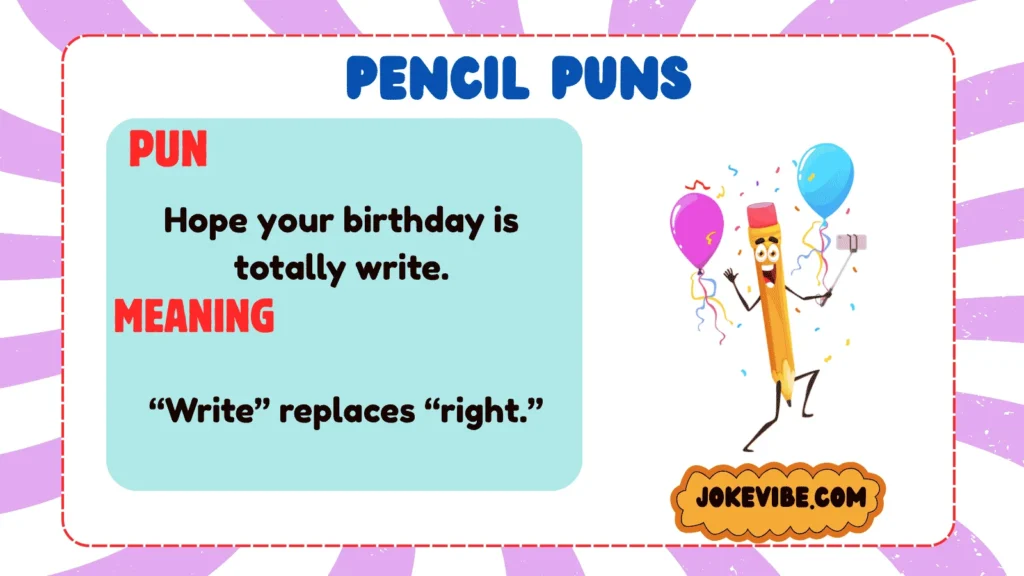
✏️ “Hope your birthday is totally write.”
Meaning: “Write” replaces “right.”
Why It’s Funny: The spelling twist makes a familiar birthday wish pencil-themed.
Best Used For: Birthday cards.
✏️ “Another year? That’s worth drawing about.”
Meaning: A birthday is treated as something worth drawing.
Why It’s Funny: “Drawing” turns a normal milestone into an art joke.
Best Used For: Artist friends.
✏️ “Stay sharp and celebrate big.”
Meaning: The birthday person is encouraged to stay clever and energetic.
Why It’s Funny: “Sharp” connects directly to a pencil.
Best Used For: Short birthday captions.
✏️ “Hope your birthday has no dull moments.”
Meaning: The birthday should be exciting, while “dull” references pencil tips.
Why It’s Funny: It works naturally as a birthday wish and a pencil pun.
Best Used For: Cards and texts.
✏️ “You’re adding another great chapter to the story.”
Meaning: Aging is compared with adding another chapter to a written story.
Why It’s Funny: It creates a subtle writing connection without being overly cheesy.
Best Used For: Thoughtful birthday messages.
✏️ “Make your next year worth a sketch.”
Meaning: The coming year should contain memorable moments worth drawing.
Why It’s Funny: It turns “sketch” into a metaphor for memories.
Best Used For: Creative birthday cards.
✏️ “May your birthday be well-rounded.”
Meaning: “Well-rounded” can describe a person while subtly referencing a pencil shape.
Why It’s Funny: The phrase sounds sophisticated but has a stationery connection.
Best Used For: Clever birthday cards.
Pencil Drawing and Art Puns
Pencils aren’t just writing tools. They’re also creative tools for artists, illustrators, designers, students, and hobbyists.
That opens up an entirely different category of wordplay involving sketches, lines, shading, portraits, drawing, outlines, doodles, and imagination.
Art puns work especially well on Instagram because the visual can provide half the joke. A photo of a sketchbook paired with a short line can be more effective than a long caption.
These jokes celebrate the creative side of pencils rather than focusing only on school supplies.
✏️ “I’m sketching out a plan.”
Meaning: A rough drawing becomes a metaphor for planning.
Why It’s Funny: “Sketching” works both literally and figuratively.
Best Used For: Artist captions.
✏️ “My ideas are shading into something beautiful.”
Meaning: Pencil shading becomes a metaphor for ideas developing.
Why It’s Funny: The creative process and drawing process overlap.
Best Used For: Art posts.
✏️ “I like my plans lightly sketched.”
Meaning: A light sketch uses faint pencil marks, while a flexible plan is not overly fixed.
Why It’s Funny: The phrase describes both artistic technique and personality.
Best Used For: Creative captions.
✏️ “This masterpiece started with one tiny line.”
Meaning: Great drawings often begin with simple marks.
Why It’s Funny: It turns the humble pencil line into the beginning of something important.
Best Used For: Art portfolios.
✏️ “Don’t shade me. I’m sensitive.”
Meaning: Shading is an art technique, while “shade” can mean subtly criticizing someone.
Why It’s Funny: The pencil gets treated like a person being insulted.
Best Used For: Social media.
✏️ “I’m outlining my future.”
Meaning: Outlining is an art technique and a planning method.
Why It’s Funny: The pencil becomes a tool for both drawing and planning life.
Best Used For: Inspirational posts.
✏️ “Great art starts with a point.”
Meaning: Pencil drawings often begin with a pointed pencil, while “point” suggests an important idea.
Why It’s Funny: A simple artistic truth becomes a philosophical statement.
Best Used For: Art captions.
Pencil Pick-Up Lines
Pencil pick-up lines are intentionally cheesy. That’s what makes them fun.
They’re best used with friends, playful texts, dating-app humor, Valentine’s Day content, or social posts where everyone understands the joke isn’t meant to be taken seriously.
The key is to keep the lines light rather than overly dramatic. A good pun-based pick-up line should make someone smile even if the answer is “no thanks.”
✏️ “Are you a pencil? Because you’ve got a sharp look.”
Meaning: The person is compared with a sharp pencil.
Why It’s Funny: “Sharp” can describe appearance, intelligence, or a pencil.
Best Used For: Playful flirting.
✏️ “Are you an eraser? Because you make my mistakes disappear.”
Meaning: The person is compared with an eraser that fixes mistakes.
Why It’s Funny: It turns emotional support into stationery romance.
Best Used For: Cute texts.
✏️ “Are you a sketchbook? Because I can picture us together.”
Meaning: Drawing and imagining a relationship are combined.
Why It’s Funny: “Picture” connects naturally to art.
Best Used For: Dating humor.
✏️ “You must be a pencil because you’ve got me on point.”
Meaning: The person has the speaker’s full attention.
Why It’s Funny: “On point” connects to the pencil tip.
Best Used For: Flirty captions.
✏️ “I’d never draw the line between us.”
Meaning: The speaker doesn’t want separation.
Why It’s Funny: “Draw the line” gets transformed into a romantic phrase.
Best Used For: Valentine’s Day.
✏️ “You make my heart sketch a little faster.”
Meaning: Excitement is expressed through drawing language.
Why It’s Funny: It combines romance with an artistic image.
Best Used For: Cute messages.
✏️ “You’re the lead character in my story.”
Meaning: Someone is the main person in the speaker’s life.
Why It’s Funny: “Lead” connects pencil lead with a main character.
Best Used For: Romantic cards.
Pencil Puns for Kids
Kids love puns when the joke is quick enough to understand and silly enough to repeat.
Pencil humor is naturally kid-friendly because pencils are familiar objects from school, homework, drawing, coloring, and crafts.
These jokes can be used by parents, teachers, librarians, children’s content creators, and anyone putting together classroom activities.
✏️ “My pencil is sharp, but my homework is sharper.”
Meaning: The homework is described as clever or difficult.
Why It’s Funny: “Sharp” applies to both the pencil and intelligence.
Best Used For: School jokes.
✏️ “I tried to draw a monster, but it erased itself.”
Meaning: An erased drawing is treated as though the monster disappeared.
Why It’s Funny: The fictional monster gets blamed for a normal pencil mistake.
Best Used For: Kids’ storytelling.
✏️ “My pencil went on vacation. It needed a little point of view.”
Meaning: The pencil gets treated like a person taking a break.
Why It’s Funny: “Point of view” receives a literal pencil twist.
Best Used For: Classroom humor.
✏️ “I sharpened my pencil and suddenly had a point.”
Meaning: Sharpening creates a point, while the phrase suggests gaining an argument.
Why It’s Funny: The physical change and figurative meaning happen together.
Best Used For: School jokes.
✏️ “The pencil joined the art club because it wanted to draw attention.”
Meaning: Drawing attention is combined with drawing pictures.
Why It’s Funny: The pencil gets a very understandable reason for joining.
Best Used For: Kids and teachers.
✏️ “My eraser is my pencil’s best friend. It always covers for me.”
Meaning: An eraser fixes mistakes while “covering for someone” means helping them out.
Why It’s Funny: The stationery relationship mirrors a human friendship.
Best Used For: Classroom jokes.
✏️ “I asked my pencil for advice. It told me to stay on point.”
Meaning: The pencil gives useful advice based on its physical point.
Why It’s Funny: A stationery item suddenly becomes a life coach.
Best Used For: Kids’ captions.
How to Use Pencil Puns
The best pencil pun depends on where you plan to use it. A joke that works perfectly on Instagram might feel strange inside a formal school assignment.
Before using a pun, think about the audience, the setting, and the purpose.
For social media, shorter is usually better. Pair the pun with a visual that reinforces the joke.
For greeting cards, choose something warm and personal rather than simply funny.
For teachers, clean wordplay can make classroom communication more memorable.
For marketing, pencil puns can help stationery brands, art stores, educational businesses, bookstores, and creative services sound more approachable.
For blogs, pencil jokes can make introductions, headings, social snippets, and promotional content more engaging.
A simple rule works almost everywhere: match the joke to the moment.
A birthday card should feel celebratory. A teacher note should feel encouraging. A romantic caption should feel playful. A business post should remain understandable and relevant.
The strongest pun isn’t necessarily the funniest one in isolation. It’s the one that fits the audience naturally.
Where to Use Pencil Puns
Social Media
Short pencil puns can make ordinary posts more memorable. Use them with photos of stationery, notebooks, sketches, desks, school supplies, or handwritten work.
Instagram is ideal for visual pencil humor. A simple photo of a sharpened pencil can work with a caption such as “Just trying to make my point.”
TikTok
Pencil puns can work as quick hooks, captions, voice-over jokes, or classroom comedy. The visual action of sharpening, snapping, or erasing a pencil can make the wordplay even stronger.
Facebook allows slightly longer jokes, making it useful for family-friendly pencil humor, teacher posts, nostalgic school jokes, and funny conversations.
Greeting Cards
Pencil puns work particularly well in handmade cards because they fit themes of writing, memories, creativity, and mistakes.
Birthday Cards
Use “stay sharp,” “no dull moments,” or “write-worthy” jokes for a quick birthday message.
Marketing
Stationery stores, bookstores, art brands, tutoring services, educational businesses, and creative companies can use pencil wordplay in headlines and social campaigns.
For example, a stationery brand could use:
“Put your best point forward.”
It’s short, relevant, and easy to remember.
Teachers
Teachers can use pencil puns on classroom posters, worksheets, reward cards, newsletters, bulletin boards, and morning announcements.
Blogs
Bloggers can use pencil jokes in introductions, section transitions, social snippets, email newsletters, or creative-writing content.
Conversation
Pencil puns are excellent icebreakers because they’re quick and harmless. A simple line like “I don’t want to make a point, but…” can set up a playful joke naturally.
How to Create Your Own Pencil Puns
Creating original pencil puns becomes much easier when you stop looking only at the word “pencil.”
Instead, build a word bank around the entire pencil ecosystem.
Start with physical terms:
- Point
- Lead
- Graphite
- Wood
- Tip
- Eraser
- Sharpener
- Shavings
- Line
- Stroke
- Color
Then add action words:
- Write
- Draw
- Sketch
- Erase
- Sharpen
- Shade
- Color
- Outline
- Scribble
Now look for everyday expressions containing those words.
For example, draw appears in “draw attention,” “draw a conclusion,” and “draw the line.”
That gives you several possible joke structures.
You can also use opposites. Pencil humor has built-in contrasts:
Sharp vs. dull
Write vs. erase
Point vs. pointless
Break vs. fix
Lead vs. follow
Those contrasts are useful because humor often comes from switching between two meanings.
Another useful technique is personification. Give the pencil a personality.
Maybe it is ambitious because it wants the lead role. Maybe it is tired because it keeps getting sharpened. Maybe it is frustrated because everyone keeps erasing its work.
The more specific the personality, the more original the joke can become.
Finally, read the pun aloud. If it sounds like something a real person might say, you’re probably close.
Tips for Writing Better Pencil Puns
Use familiar phrases. The reader should recognize the original expression before you twist it.
Keep the setup short. Don’t explain the joke before delivering it.
Exploit double meanings. Words such as “point,” “sharp,” “draw,” and “lead” are especially useful.
Make the punchline specific. Generic jokes feel forgettable. A specific pencil detail creates a stronger image.
Don’t force every joke. If the wordplay feels unnatural, discard it.
Match the audience. A teacher joke and a romantic caption shouldn’t sound identical.
Use visuals when possible. A pencil photograph can make an ordinary caption funnier.
Avoid repeating the same structure. Ten versions of “Why did the pencil…” quickly become predictable.
Add personality. Personified pencils often create more memorable jokes.
Read everything aloud. Good puns should sound natural when spoken.
Common Mistakes When Writing Pencil Puns
One common mistake is overusing the same words. “Sharp,” “point,” and “lead” are useful, but relying on them for every joke makes the collection feel repetitive.
Another mistake is explaining too much. If the reader needs a paragraph to understand a one-line pun, the joke probably needs rewriting.
It’s also easy to confuse cleverness with complexity. A complicated pun isn’t automatically a better pun. The strongest wordplay often uses an everyday phrase and changes one small detail.
Another problem is ignoring the audience. A joke intended for young students should be clean and simple. A joke for artists can use more specific terms such as shading, graphite, contour, and sketching.
Writers should also avoid copying familiar internet jokes. Pencil humor has been around for a long time, so originality requires looking beyond the most obvious setups.
Instead of asking, “What joke can I make about a pencil?” ask:
“What unusual situation would a pencil find itself in?”
That question opens up much more creative territory.
Pencil Puns for Bloggers, Writers, and Content Creators
Writers have a natural connection to pencil humor because writing itself provides so much material.
You can use pencil puns as article hooks, newsletter subject ideas, social captions, section transitions, or creative prompts.
For example, a writing blog might open with:
“Every great idea starts somewhere. Sometimes, it starts with a pencil that refuses to stay sharp.”
A creativity newsletter could use:
“Don’t erase the weird ideas. Some of them become your best work.”
A stationery brand might use:
“Make your next idea worth the point.”
The important thing is relevance. A pun should support the content rather than distract from it.
For SEO content, semantic relevance also matters. Pencil-related language can naturally include terms such as writing tools, graphite pencils, mechanical pencils, sketching, drawing, stationery, school supplies, notebooks, erasers, sharpeners, handwriting, art supplies, and creative writing.
That gives readers more useful context while keeping the content centered on pencil humor.
Pencil Puns for Social Media Captions
A good social caption needs to be quick enough to scan and distinctive enough to remember.
Pencil humor is particularly useful for educational accounts, stationery creators, artists, writers, teachers, bookstores, and school-related brands.
Try pairing a short pun with a visual:
Photo of a sharpened pencil:
“Fresh point of view.”
Sketchbook photo:
“Just drawing my own conclusions.”
Desk setup:
“Keeping my thoughts on point.”
Pencil shavings:
“Things got a little sharp.”
Notebook and pencil:
“Putting ideas to paper, one point at a time.”
The visual doesn’t have to literally show a pencil. A handwritten quote, drawing, classroom desk, or notebook can provide enough context.
For TikTok and Reels, you can also build a mini-joke around an action. Start with a dull pencil, sharpen it dramatically, then add text such as:
“Me after one productive thought.”
The joke works because the physical action supports the metaphor.
Internal Link Ideas for Related Content
If you’re building a larger humor or pun website, pencil content can naturally connect with other wordplay topics.
Consider adding internal links to related articles such as:
- Banana Puns
- Orange Puns
- Food Puns
- Pumpkin Puns
- Dad Jokes
- Funny Captions
- School Puns
- Art Puns
- Writing Puns
- Back-to-School Puns
- Teacher Puns
- Book Puns
- Notebook Puns
- Paper Puns
These links can help readers discover related humor while also strengthening topical relationships across your site.
FAQs
What are pencil puns?
Pencil puns are jokes based on pencils, writing, drawing, erasers, sharpeners, graphite, and related words. They usually create humor by giving words such as “point,” “sharp,” “lead,” or “draw” a second meaning.
What is a funny pencil pun?
A funny pencil pun is a short joke that combines pencil terminology with an unexpected meaning. For example, “I don’t want to make a point, but…” can lead into a joke about a pencil’s point.
What are good pencil puns for Instagram?
Short lines work best on Instagram. Examples include “Just trying to make my point,” “Keeping things sharp,” and “Life gets sketchy sometimes.”
What are some pencil puns for teachers?
Teachers can use clean jokes such as “Stay sharp,” “Make your point,” “Don’t let one mistake erase your confidence,” and “Sharpen your skills, not your excuses.”
Can pencil puns be used in birthday cards?
Yes. Pencil birthday puns are useful for quick, playful messages. Lines about staying sharp, avoiding dull moments, or making the next year write-worthy can fit nicely inside birthday cards.
Why do pencil puns work so well?
Pencil vocabulary contains many words with multiple meanings. Terms such as “point,” “lead,” “sharp,” “draw,” “line,” and “erase” can be used literally and figuratively, creating natural opportunities for wordplay.
How can I make my own pencil puns?
Start with pencil-related words such as point, lead, draw, write, erase, sketch, sharp, and line. Then connect each word to a familiar phrase or everyday situation. The strongest jokes usually come from unexpected connections.
Are pencil puns good for kids?
Yes. Pencil humor is generally easy to make clean, simple, and classroom-friendly. Kids can enjoy jokes about sharpening, erasing, drawing, writing, school, homework, and pencils getting lost.
Final Thoughts
A pencil may look like one of the simplest objects on a desk, but it has an impressive amount of comedic potential. It can have a point, carry the lead, get sharp, become dull, draw attention, cross a line, make mistakes, and then erase them. That’s a surprisingly large vocabulary for something that usually lives in a pencil case.
The best pencil puns don’t rely on complicated jokes. They take familiar words and give them a fresh little twist. That’s why they work for so many audiences.
Students can use them to make schoolwork more fun. Teachers can turn them into classroom jokes. Artists can use them as captions. Writers can build them into creative content. Friends can drop them into conversations. Parents can add them to cards. Brands can even use them to make stationery or educational marketing feel more memorable.
And the best part is that you don’t have to stop with the jokes above.
Once you start noticing the double meanings hidden inside words like point, lead, sharp, draw, erase, sketch, line, and write, you’ll begin finding your own combinations everywhere.
So grab a pencil, sharpen your creativity, and start experimenting.
Make a point.
Draw a line.
Erase the bad ideas.
Keep the good ones.
And above all, don’t let your humor get dull.
After all, every great pun deserves a good point.

I’m Naqash Ayub, and I believe a great pun can make any day better. At Jokevibe, I create original wordplay, witty jokes, and fun content that’s simple to read, easy to share, and guaranteed to bring a smile.


