Japan puns are a fun way to turn Japanese culture, travel, food, language, anime, and everyday experiences into clever wordplay. Whether you are looking for a funny caption, a message for a friend, a travel post, or simply a few jokes to brighten your day, the right Japan pun can make a simple sentence much more memorable.
This article was updated for 2026 with fresh, original jokes designed for real conversations, social media, cards, and creative writing.
What makes Japan themed puns so enjoyable is the sheer number of ideas you can play with. Tokyo, sushi, ramen, karaoke, Mount Fuji, cherry blossoms, samurai, anime, trains, tea, and Japanese phrases all offer plenty of material. You can make a pun clever, cute, silly, romantic, or wonderfully cheesy depending on the occasion.
You might use these jokes on Instagram, TikTok, Facebook, birthday cards, greeting cards, travel photos, classroom activities, conversations with friends and family, marketing campaigns, or blog posts. Even teachers and content creators can use them to make an ordinary sentence more memorable.
Quick Answer: What Are Japan Puns?
Japan puns are jokes and wordplay inspired by Japan, Japanese words, food, places, traditions, pop culture, and travel. They often combine familiar English phrases with Japan-related ideas to create a surprising twist. For example, “I’m Tokyo-tally excited!” turns “totally” into a playful reference to Tokyo.
What’s Inside
| Section | What You’ll Find |
|---|---|
| Best Japan Puns | Clever all-around Japan jokes |
| Funny Japan Puns | Silly jokes for friends and conversations |
| Cute Japan Puns | Sweet and wholesome wordplay |
| Japan Travel Puns | Captions for adventures and vacations |
| Tokyo Puns | City-themed jokes and captions |
| Sushi Puns | Food lovers’ favorite wordplay |
| Anime & Manga Puns | Playful pop-culture jokes |
| Japanese Food Puns | Ramen, matcha, rice, and more |
| Japan Love Puns | Romantic and flirty lines |
| Japan Instagram Captions | Short social-media-ready jokes |
| Japan Birthday Puns | Birthday cards and messages |
| Japan Puns for Kids | Simple family-friendly jokes |
| Japan Dad Jokes | Classic groan-worthy humor |
| Japan One-Liners | Quick jokes for conversations |
| Japan Pick-Up Lines | Cheesy romantic wordplay |
| Japan Puns for Travelers | Vacation and sightseeing humor |
| How to Create Japan Puns | Practical writing tips |
| Where to Use Them | Social media, cards, blogs, and more |
| FAQs | Quick answers to common questions |
What Are Japan Puns?
Japan puns are a form of wordplay built around Japanese places, foods, language, customs, travel experiences, and cultural references. The basic idea is simple: take something familiar and give it a Japan-inspired twist.
For example, “I’m having a Tokyo-tally amazing day” plays on the sound of “totally.” The humor comes from recognizing the familiar phrase while noticing the unexpected Tokyo reference.
Good puns do not always require deep knowledge of Japan. Some rely on universally recognizable things such as sushi, ramen, karaoke, or Mount Fuji. Others use Japanese words such as kawaii, arigato, sayonara, or konichiwa.
The best Japan puns also work because they are easy to understand. A reader should not need a long explanation before getting the joke.
Japan offers an especially rich playground for wordplay. You have cities, foods, landmarks, anime, trains, tea ceremonies, cherry blossoms, temples, technology, and countless travel experiences to work with.
Here are a few examples:
“I’m Tokyo-tally ready for an adventure.”
“Sushi and I could be best friends.”
“Fuji kidding me? This view is incredible!”
“Matcha love for Japan is impossible to hide.”
The goal is not to force Japanese words into every sentence. Instead, the strongest jokes find a natural connection between an English phrase and a Japan-related idea.
That is what makes a pun feel clever rather than random.
Why Wordplay Works So Well
Puns create a tiny moment of surprise. Your brain expects one word or phrase, but the sentence suddenly takes a different direction.
That surprise is the joke.
With Japan puns, you can build that surprise around pronunciation, place names, cultural references, food, or familiar expressions.
A good pun should feel like something the reader could have thought of themselves—just a little too late.
That “Oh, I get it!” moment is exactly what makes wordplay satisfying.
Why Are Japan Puns So Popular?
Japan has become a huge source of inspiration for travelers, food lovers, anime fans, photographers, students, creators, and pop-culture communities. That gives Japan-themed humor an unusually broad audience.
In real conversations, people often use puns when they want to make a message feel less serious. A simple “Have a great trip” is perfectly fine. But “Have a Fuji-nomenal trip!” adds personality.
The same thing happens on social media.
A beautiful photo of Mount Fuji might already look impressive, but a caption such as “Peak happiness” gives the post an extra layer of humor.
From a humor-writing perspective, the strongest Japan puns usually have three things going for them: recognition, surprise, and simplicity.
Recognition means the reader understands the reference. Surprise means the wording takes an unexpected turn. Simplicity means the joke lands quickly.
Japan also gives writers plenty of familiar vocabulary. Tokyo, Kyoto, sushi, ramen, matcha, sake, Fuji, ninja, samurai, anime, manga, karaoke, and cherry blossoms are instantly recognizable to many English-speaking readers.
That makes them useful for captions, greeting cards, blog headlines, classroom jokes, travel content, and casual messages.
The important thing is to keep the humor respectful. Japan is a real country with a rich and varied culture, so jokes work best when they celebrate recognizable experiences rather than reducing the culture to stereotypes.
A clever food pun is usually safer and funnier than a joke built around a caricature.
That balance gives Japan puns their staying power.
Best Japan Puns
Sometimes you do not need a specific category. You just want a handful of strong Japan puns that can work almost anywhere.
This collection focuses on flexible jokes you can use in conversations, captions, travel posts, cards, or casual messages. They are intentionally short enough to remember but developed enough to have an actual punchline.
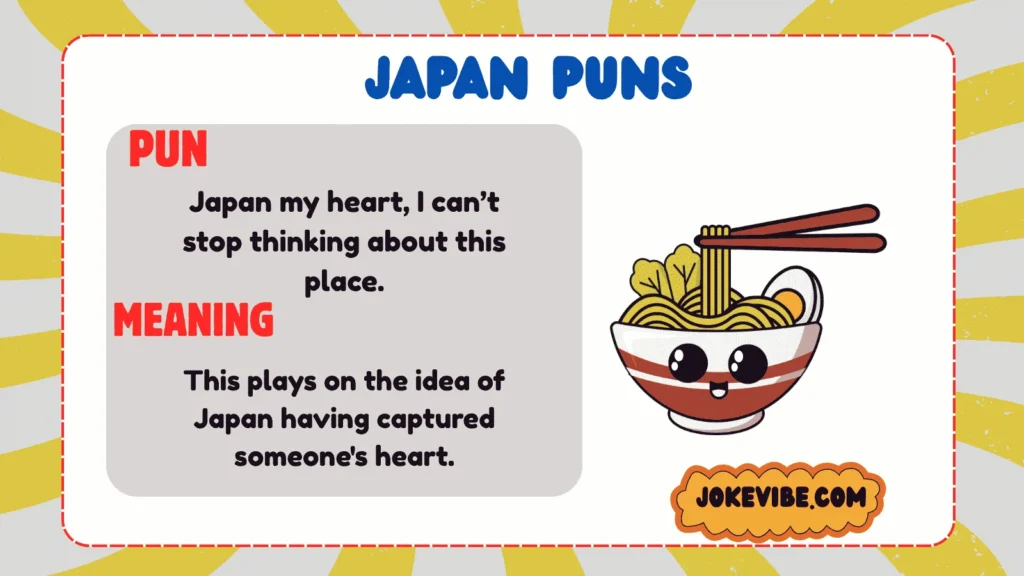
🇯🇵 Pun
“Japan my heart, I can’t stop thinking about this place.”
Meaning: This plays on the idea of Japan having captured someone’s heart.
Why It’s Funny: “Japan my heart” sounds like a playful version of a romantic phrase while connecting the joke directly to the country.
Best Used For: Travel captions, postcards, or messages to someone who loves Japan.
🍜 Pun
“I came for the views, but I stayed for the ramen.”
Meaning: The speaker expected the scenery to be the highlight but became equally attached to Japanese food.
Why It’s Funny: It turns a travel expectation into a food confession.
Best Used For: Vacation posts, food blogs, and restaurant photos.
🗻 Pun
“Fuji kidding me? This view is unreal.”
Meaning: “Fuji” replaces “Are you kidding me?” to emphasize how impressive the view is.
Why It’s Funny: The familiar phrase becomes unexpectedly tied to Mount Fuji.
Best Used For: Mount Fuji photos and travel captions.
🍵 Pun
“Matcha later, I’m busy enjoying Japan.”
Meaning: “Matcha” sounds like “much” in a playful phrase.
Why It’s Funny: The joke combines a familiar expression with matcha, one of Japan’s best-known drinks.
Best Used For: Tea photos, travel stories, and café posts.
🚄 Pun
“This trip is going train-mendously well.”
Meaning: “Train-mendously” combines “train” with “tremendously.”
Why It’s Funny: Japan is famous for its rail network, so the train reference fits naturally.
Best Used For: Bullet train photos, travel reels, and railway enthusiasts.
Funny Japan Puns
Funny Japan puns do not need to be sophisticated. Sometimes the best joke is the one that makes people groan before they laugh.
These are designed for casual humor. They work especially well when you are chatting with friends or writing a caption that should sound playful rather than polished.
The trick with silly puns is commitment. If the joke is intentionally cheesy, lean into it.
A perfectly ridiculous pun can be much funnier than a joke that tries too hard to sound clever.
😂 Pun
“I’m having a Japan-demonium kind of day.”
Meaning: “Japan-demonium” blends Japan with “pandemonium.”
Why It’s Funny: It exaggerates the excitement of being surrounded by new sights, sounds, food, and experiences.
Best Used For: Busy travel days, group chats, and funny vacation updates.
🍣 Pun
“Sushi you later!”
Meaning: This replaces “see you later” with “sushi.”
Why It’s Funny: The sentence sounds almost normal until the food reference lands.
Best Used For: Sushi restaurant posts, goodbye messages, or food-themed jokes.
🥢 Pun
“I’m trying to keep my Japan cool.”
Meaning: This plays on “keep your cool” while adding Japan as the subject.
Why It’s Funny: The phrase sounds like a serious piece of advice until Japan unexpectedly becomes part of it.
Best Used For: Casual conversations and travel captions.
🎤 Pun
“Karaoke? I’m totally Japan to it.”
Meaning: The joke treats Japan as though it were a verb meaning “ready or willing.”
Why It’s Funny: It intentionally bends language in a silly way.
Best Used For: Karaoke nights, party invitations, and humorous stories.
🥟 Pun
“I’m dumpling into Japanese food way too quickly.”
Meaning: “Dumpling” replaces the idea of diving or jumping into something.
Why It’s Funny: The exaggerated food metaphor makes the sentence playful.
Best Used For: Restaurant posts and food adventures.
Cute Japan Puns
Cute Japan puns are ideal when you want something sweet without sounding overly romantic. They work well for Instagram captions, cards, messages between friends, and photos featuring cherry blossoms, Japanese gardens, cafés, or adorable souvenirs.
Japan already has a strong association with cute aesthetics, colorful stationery, charming characters, and kawaii culture. That gives writers plenty of opportunities to create lighthearted lines.
The best cute puns are warm and simple. They should make someone smile rather than demand a huge laugh.
🌸 Pun
“You make every day feel cherry special.”
Meaning: “Cherry” replaces “very” while referencing cherry blossoms.
Why It’s Funny: The small sound change turns an ordinary compliment into a Japan-inspired one.
Best Used For: Friendship messages, spring photos, and cherry blossom captions.
🐱 Pun
“You’re purr-fectly kawaii.”
Meaning: “Purr-fectly” adds a cat-related pun to the Japanese word “kawaii,” meaning cute.
Why It’s Funny: It combines two different forms of cuteness in one short line.
Best Used For: Cute photos, pet posts, and playful messages.
🌸 Pun
“Life is blossom-ing beautifully.”
Meaning: The word “blossoming” becomes a playful reference to Japan’s famous cherry blossoms.
Why It’s Funny: It connects personal growth with a visual symbol strongly associated with Japan.
Best Used For: Spring posts, inspirational captions, and travel memories.
🍵 Pun
“You’re my matcha-made friend.”
Meaning: This plays on “match made” by adding matcha.
Why It’s Funny: Matcha becomes the unexpected ingredient in a friendship phrase.
Best Used For: Friendship cards, café photos, and best-friend captions.
🗻 Pun
“You make my happiness reach new peaks.”
Meaning: “Peaks” refers both to emotional highs and Japan’s mountains.
Why It’s Funny: The double meaning stays subtle instead of forcing a complicated joke.
Best Used For: Scenic photos, friendship posts, and positive messages.
Japan Travel Puns
Travel and Japan puns are almost impossible to separate. Japan is packed with destinations that naturally lend themselves to captions, including Tokyo, Kyoto, Osaka, Nara, Hokkaido, Okinawa, and Mount Fuji.
Travel puns are especially useful because social media captions often need to be short. A clever line can tell people where you are while also adding personality.
Instead of writing “Japan was amazing,” you can write something that communicates the same feeling with a little more character.
These jokes work for vacation albums, travel blogs, TikTok videos, postcards, and group chats.
✈️ Pun
“Japan has officially raised my travel standards.”
Meaning: The trip was so impressive that future vacations now have a difficult benchmark to beat.
Why It’s Funny: It exaggerates how good the trip was without relying on complicated wordplay.
Best Used For: Travel recaps and vacation captions.
🗺️ Pun
“I’m completely lost in Japan—and loving every minute.”
Meaning: Being physically lost becomes a metaphor for being completely absorbed in the experience.
Why It’s Funny: The sentence turns a potentially stressful situation into a positive travel moment.
Best Used For: Street photography, wandering videos, and adventure posts.
🚅 Pun
“My itinerary is moving at bullet speed.”
Meaning: The joke references Japan’s bullet trains and a packed travel schedule.
Why It’s Funny: The travel plan itself is treated like a Shinkansen.
Best Used For: Train trips and busy itineraries.
🎒 Pun
“I packed light, but Japan gave me heavy memories.”
Meaning: The physical luggage stayed light while the emotional memories became significant.
Why It’s Funny: It contrasts literal weight with emotional value.
Best Used For: End-of-trip posts and reflective captions.
🧳 Pun
“Dear suitcase, prepare yourself for a Japan-sized adventure.”
Meaning: The suitcase is humorously addressed as though it has feelings.
Why It’s Funny: Personifying luggage gives a simple packing joke a playful twist.
Best Used For: Before-trip posts, packing videos, and travel stories.
Tokyo Puns
Tokyo is one of the easiest Japanese destinations to turn into wordplay because its name resembles several familiar English sounds and phrases.
Tokyo puns can work particularly well for city photos, nightlife content, travel reels, food posts, and urban photography.
Because Tokyo itself is so visually varied, you can match the joke to almost any kind of photo: skyscrapers, trains, cafés, shopping streets, temples, neon signs, or quiet neighborhoods.
The strongest Tokyo jokes do not need to mention every famous landmark. Sometimes simply twisting the word “Tokyo” is enough.
🏙️ Pun
“I’m Tokyo-tally obsessed with this city.”
Meaning: “Tokyo-tally” plays on “totally.”
Why It’s Funny: The city name fits naturally into a familiar expression.
Best Used For: Tokyo travel photos and city captions.
🌃 Pun
“Tokyo has me feeling city-sfied.”
Meaning: “City-sfied” is a playful combination suggesting complete satisfaction with city life.
Why It’s Funny: The invented word gives the sentence a quirky urban feel.
Best Used For: Nighttime city photos and lifestyle posts.
🚶 Pun
“Tokyo steps ahead of my expectations.”
Meaning: Tokyo is described as being ahead of expectations, while “steps” suggests exploring the city on foot.
Why It’s Funny: The phrase works as both a compliment and a travel reference.
Best Used For: Walking tours and sightseeing posts.
🌆 Pun
“I came, I saw, I Tokyo-tally fell in love.”
Meaning: “Tokyo-tally” replaces “totally.”
Why It’s Funny: It turns the city name into a natural-sounding intensifier.
Best Used For: Romantic travel captions and city memories.
🚇 Pun
“Tokyo is always on the right track.”
Meaning: The phrase refers to being successful while also referencing Tokyo’s extensive rail system.
Why It’s Funny: The literal train meaning gives the familiar expression a second layer.
Best Used For: Train photos, transportation posts, and city guides.
Sushi Puns
Sushi is one of the most recognizable Japanese foods around the world, which makes it a natural source of wordplay.
Food puns are especially useful because the audience usually understands the reference immediately. You do not need to explain what sushi is before the joke can work.
Sushi puns can be funny, cute, romantic, or deliberately cheesy. They are also perfect for menus, restaurant marketing, social captions, birthday cards, and food blogs.
The best sushi jokes usually involve familiar phrases such as “see you,” “roll,” “raw,” “rice,” or “good.”
🍣 Pun
“Sushi you were here!”
Meaning: “Sushi” replaces “wish” or “see” in a familiar-sounding phrase.
Why It’s Funny: The food reference creates an intentionally silly sentence.
Best Used For: Sushi photos and food-related posts.
🍣 Pun
“You’re on a roll, and so is the sushi.”
Meaning: The phrase “on a roll” describes success while also describing sushi preparation.
Why It’s Funny: The same phrase has both an everyday and food-related meaning.
Best Used For: Celebrating achievements, restaurant posts, or encouragement.
🍚 Pun
“Rice to meet you, sushi!”
Meaning: “Rice to meet you” replaces “nice to meet you.”
Why It’s Funny: Rice is a familiar sushi companion, making the substitution easy to understand.
Best Used For: Introductions, food captions, and silly messages.
🥢 Pun
“Let’s roll with it.”
Meaning: “Roll” refers to sushi rolls while also meaning to go along with a situation.
Why It’s Funny: The joke is subtle enough to sound like a normal phrase.
Best Used For: Sushi dinners, group messages, and casual captions.
🍣 Pun
“That sushi was soy good.”
Meaning: “Soy” replaces “so.”
Why It’s Funny: The tiny substitution immediately adds a Japanese-food reference.
Best Used For: Restaurant reviews, food photography, and short captions.
Japanese Food Puns
Japan’s food culture offers much more than sushi. Ramen, tempura, matcha, mochi, rice, udon, soba, onigiri, and countless other dishes provide endless opportunities for playful writing.
Food puns are also useful for bloggers and marketers because they can make otherwise ordinary descriptions more memorable.
A restaurant might use a playful phrase to name a promotion. A food blogger can use one as a headline. A traveler can use one as a caption.
The important rule is to make sure the pun still communicates something useful. Humor should add flavor, not replace the information.
🍜 Pun
“Ramen-tic evenings are my favorite.”
Meaning: “Ramen-tic” combines ramen with romantic.
Why It’s Funny: It transforms a familiar romantic word into a noodle-themed joke.
Best Used For: Date-night food posts and restaurant captions.
🍵 Pun
“Matcha, matcha, matcha—wherever I go, I find another cup.”
Meaning: The repeated word creates a playful rhythm around matcha.
Why It’s Funny: It exaggerates how often a matcha lover encounters the drink.
Best Used For: Café reels, matcha photos, and foodie captions.
🍡 Pun
“Mochi appreciate this dessert more?”
Meaning: “Mochi” sounds like “much” in “much appreciate.”
Why It’s Funny: A dessert becomes part of an exaggerated compliment.
Best Used For: Dessert photos and food reviews.
🍜 Pun
“Udon know how happy this bowl made me.”
Meaning: “Udon” sounds like “you don’t.”
Why It’s Funny: The noodle name slips naturally into a familiar phrase.
Best Used For: Udon photos and restaurant posts.
🍚 Pun
“Rice and shine!”
Meaning: “Rice” replaces “rise” in the phrase “rise and shine.”
Why It’s Funny: It turns a morning expression into a food joke.
Best Used For: Breakfast posts, rice dishes, and cheerful morning captions.
Anime and Manga Puns
Anime and manga are major parts of modern Japanese pop culture, so they naturally appear in Japan-themed humor.
The challenge is avoiding jokes that depend on one very specific fandom reference. A broad anime pun can reach more readers than a joke that only makes sense to people who have watched a particular series.
These lines are designed to work for anime fans while remaining understandable to casual readers.
They can fit convention photos, cosplay posts, manga collections, streaming nights, and conversations between friends.
🎌 Pun
“I’m totally anime-zed by this trip.”
Meaning: “Anime-zed” combines anime with “amazed.”
Why It’s Funny: The word itself becomes a miniature anime reference.
Best Used For: Anime conventions, Japan travel posts, and fan captions.
📖 Pun
“This manga is turning the page on my free time.”
Meaning: Reading manga is humorously blamed for consuming someone’s spare time.
Why It’s Funny: “Turning the page” becomes both literal reading and a metaphor for moving forward.
Best Used For: Manga collections and reading posts.
🎮 Pun
“My weekend has entered its main-character arc.”
Meaning: The phrase references the storytelling structure common in anime while describing an exciting weekend.
Why It’s Funny: An ordinary weekend is exaggerated into an anime storyline.
Best Used For: Weekend captions, cosplay posts, and lifestyle content.
✨ Pun
“Plot twist: I bought another manga.”
Meaning: A predictable purchase is presented like a dramatic story reveal.
Why It’s Funny: The joke treats shopping like an unexpected anime plot development.
Best Used For: Bookstore photos and manga collections.
🎭 Pun
“I came for one episode and stayed for the whole character arc.”
Meaning: The speaker intended to watch briefly but became invested in the story.
Why It’s Funny: It captures a familiar binge-watching experience.
Best Used For: Anime streaming posts and relatable social captions.
Japan Love Puns
Romantic Japan puns can be surprisingly charming when they stay simple. You do not need an elaborate declaration. A short line connected to sushi, Tokyo, cherry blossoms, or travel can make a message feel personal.
These are useful for Valentine’s Day, anniversary cards, date-night captions, travel photos with a partner, or playful texts.
The best romantic puns sound affectionate first and silly second.
❤️ Pun
“You’re the only one I’d cross oceans for—and Japan included.”
Meaning: The speaker uses travel to express romantic devotion.
Why It’s Funny: The grand romantic statement gets a playful geographic addition.
Best Used For: Anniversary posts and romantic cards.
🌸 Pun
“Our love keeps blossom-ing.”
Meaning: The relationship is compared to cherry blossoms opening.
Why It’s Funny: The seasonal imagery adds a gentle Japan connection.
Best Used For: Spring anniversaries and romantic captions.
🍣 Pun
“We’re a perfect sushi-uation.”
Meaning: “Sushi-uation” playfully transforms “situation” into a sushi reference.
Why It’s Funny: It describes a relationship using an unexpected food word.
Best Used For: Couples’ food photos and playful messages.
🗻 Pun
“My love for you has no peak.”
Meaning: The phrase connects unlimited love with mountain peaks.
Why It’s Funny: Mount Fuji and Japanese mountain scenery sit quietly behind the romantic meaning.
Best Used For: Romantic captions and cards.
🍵 Pun
“You’re my matcha forever.”
Meaning: “Matcha” replaces “match” in a romantic phrase.
Why It’s Funny: The familiar romantic idea becomes a tea-themed declaration.
Best Used For: Valentine’s cards, tea dates, and cute texts.
Japan Instagram Captions
Instagram captions need to work quickly. People usually see the photo before reading the text, so a long setup can lose attention.
That is why short Japan puns are particularly effective on Instagram.
A good caption should complement the image rather than compete with it. A Mount Fuji photo needs a different joke from a sushi dinner, and a Tokyo skyline deserves a different line from a cherry blossom selfie.
These captions are short enough to use as-is or combine with your own travel details.
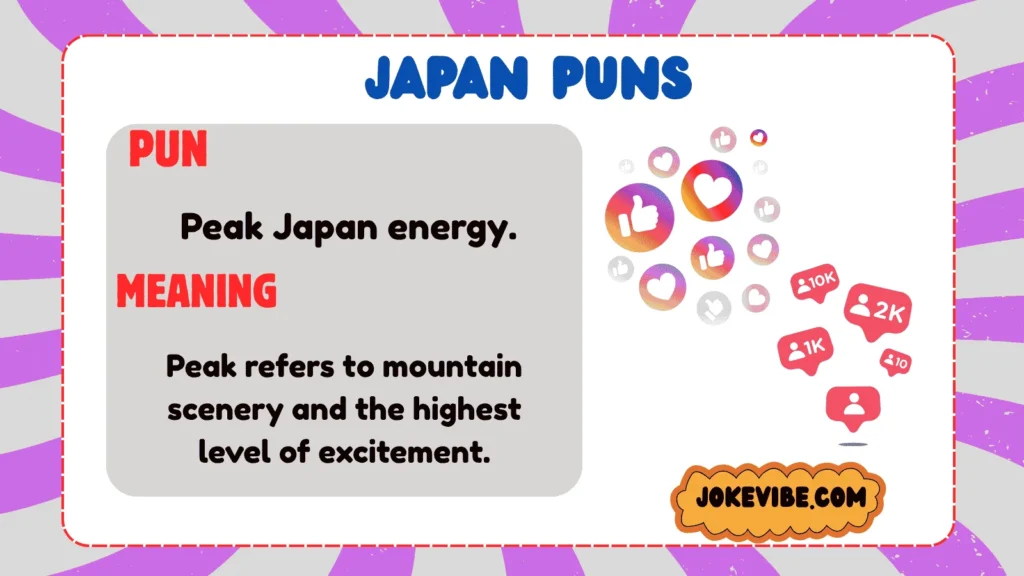
📸 Pun
“Peak Japan energy. 🗻”
Meaning: “Peak” refers to mountain scenery and the highest level of excitement.
Why It’s Funny: One word carries both the literal and figurative meaning.
Best Used For: Mountain and scenic travel photos.
🌸 Pun
“Just out here blossom-ing.”
Meaning: The speaker is playfully comparing their travel experience to flowers blooming.
Why It’s Funny: It turns a normal activity into a cute seasonal metaphor.
Best Used For: Cherry blossom photos.
🍣 Pun
“Rollin’ through Japan. 🍣”
Meaning: “Rollin’” references sushi rolls and traveling around the country.
Why It’s Funny: The travel and food meanings fit together naturally.
Best Used For: Food-and-travel photo dumps.
🏙️ Pun
“Tokyo stole my whole itinerary.”
Meaning: Tokyo was so enjoyable that it became the main focus of the trip.
Why It’s Funny: The city is treated like a person capable of stealing something.
Best Used For: Tokyo vacation posts.
🍵 Pun
“Matcha made in Japan.”
Meaning: This twists “match made in heaven” into a matcha reference.
Why It’s Funny: It connects romance-style wording with Japanese tea.
Best Used For: Matcha photos, cafés, and Japan travel posts.
Japan Birthday Puns
Birthday messages do not have to be serious. A Japan-themed birthday pun can make a card, text, or social post stand out.
These jokes work best when they remain positive. Birthdays are celebrations, so the humor should focus on food, travel, happiness, adventure, and getting another year of experience.
If the birthday person loves Japan, even a small reference can make the message feel customized.
🎂 Pun
“Have a Fuji-nomenal birthday!”
Meaning: “Fuji-nomenal” combines Fuji with phenomenal.
Why It’s Funny: The familiar compliment gets a Japanese landmark makeover.
Best Used For: Birthday cards and social posts.
🎉 Pun
“Hope your birthday is Tokyo-tally awesome!”
Meaning: “Tokyo-tally” replaces “totally.”
Why It’s Funny: The place name fits neatly into a familiar expression.
Best Used For: Birthday texts and captions.
🍣 Pun
“Another year? Soy what? Let’s celebrate!”
Meaning: “Soy” replaces “so.”
Why It’s Funny: A tiny food pun makes an ordinary birthday statement more playful.
Best Used For: Sushi-loving friends.
🍜 Pun
“Ramen proud of how far you’ve come.”
Meaning: “Ramen” replaces “I’m” in a humorous sentence.
Why It’s Funny: The noodle reference turns a sincere compliment into a silly birthday message.
Best Used For: Birthday cards for close friends.
🌸 Pun
“May your new year be full of cherry good moments.”
Meaning: “Cherry” replaces “very.”
Why It’s Funny: The phrase feels familiar while giving the birthday message a Japanese springtime flavor.
Best Used For: Birthday wishes and cheerful captions.
Japan Puns for Kids
Kids generally respond best to puns they can understand immediately. Food, animals, trains, mountains, and simple word substitutions are excellent starting points.
Japan-themed jokes can also be useful for teachers, parents, school projects, travel activities, and classroom discussions.
The goal is not to make every joke sophisticated. A child-friendly pun should be easy enough to repeat.
If kids can tell the joke to someone else without needing help explaining it, you have probably found the right level.
🐟 Pun
“Why did the sushi get promoted?”
“Because it was on a roll!”
Meaning: “On a roll” means doing well and also describes sushi.
Why It’s Funny: Kids can understand both meanings quickly.
Best Used For: Classrooms, lunch jokes, and family conversations.
🚄 Pun
“Why was the Japanese train so confident?”
“Because it was always on track!”
Meaning: Being “on track” means doing well while also referring to trains.
Why It’s Funny: The literal train reference makes the phrase funny.
Best Used For: Travel lessons and kid-friendly jokes.
🍚 Pun
“What did the rice say before school?”
“Rice and shine!”
Meaning: “Rice” replaces “rise.”
Why It’s Funny: The familiar morning phrase becomes food-related.
Best Used For: Breakfast jokes and classroom activities.
🍵 Pun
“Why did the matcha get invited everywhere?”
“Because it was always a great tea-m!”
Meaning: “Tea-m” sounds like “team.”
Why It’s Funny: The drink becomes part of a familiar word.
Best Used For: School activities and tea-themed humor.
🗻 Pun
“Why did the mountain stay calm?”
“Because it knew how to peak under pressure.”
Meaning: “Peak” refers to the top of a mountain and doing well under pressure.
Why It’s Funny: The mountain meaning makes the expression unexpected.
Best Used For: Kids, classrooms, and family jokes.
Japan Dad Jokes
Dad jokes are supposed to be cheesy. In fact, the groan is part of the experience.
Japan-themed dad jokes work especially well because Japanese food, trains, cities, and landmarks provide plenty of simple double meanings.
The secret is not to overcomplicate them. Dad humor thrives on obvious wordplay delivered with complete confidence.
👨🦳 Pun
“I wanted to tell a Tokyo joke, but it was too city-fied.”
Meaning: The joke plays with “city” and a made-up variation of “satisfied.”
Why It’s Funny: The wording is intentionally awkward in classic dad-joke fashion.
Best Used For: Family gatherings and casual conversations.
🍣 Pun
“I opened a sushi restaurant, but business is on a roll.”
Meaning: The business is successful, while sushi is literally rolled.
Why It’s Funny: The phrase has a clear business meaning and food meaning.
Best Used For: Restaurant jokes and family humor.
🍜 Pun
“I told my ramen a secret. It said, ‘Noodle what?’”
Meaning: “Noodle what?” plays on “know what?”
Why It’s Funny: The noodle becomes a conversation partner.
Best Used For: Kids, food lovers, and dad-joke fans.
🚄 Pun
“I love Japanese trains. They really know how to conduct themselves.”
Meaning: “Conduct” refers both to behavior and operating a train.
Why It’s Funny: The serious expression gets a railway twist.
Best Used For: Train enthusiasts and travel conversations.
🍵 Pun
“I asked for Japanese tea advice, but they told me to steep calm.”
Meaning: “Steep calm” sounds like “keep calm.”
Why It’s Funny: The familiar phrase gets converted into tea language.
Best Used For: Tea lovers and classic dad-joke moments.
Japan One-Liners
One-liners are useful when you want humor without a setup or explanation.
They can work as captions, profile text, conversation starters, tweet-style posts, or quick additions to a travel story.
A strong one-liner should be compact enough to read in a second but still have a clear twist.
🎌 Pun
“Japan and I are getting along famously.”
Meaning: The speaker describes their trip as a successful relationship.
Why It’s Funny: A country becomes the subject of a friendship-style statement.
Best Used For: Travel captions.
🍣 Pun
“Sushi happens.”
Meaning: This twists the familiar phrase “stuff happens.”
Why It’s Funny: The food substitution is immediate and silly.
Best Used For: Casual food posts.
🗻 Pun
“I’ve reached my peak vacation.”
Meaning: The trip has reached its best point while referencing mountains.
Why It’s Funny: It works both emotionally and geographically.
Best Used For: Scenic travel photos.
🍵 Pun
“Matcha made my day.”
Meaning: Matcha is credited with improving the speaker’s day.
Why It’s Funny: The phrase sounds close to a familiar romantic expression.
Best Used For: Café photos and morning posts.
🚅 Pun
“Japan has me moving at full steam.”
Meaning: The phrase describes both excitement and train travel.
Why It’s Funny: Steam-powered imagery meets modern travel humor.
Best Used For: Train photos and energetic travel updates.
Japan Pick-Up Lines
Japan-themed pick-up lines are deliberately cheesy. They are best used when both people already enjoy playful humor.
The goal is not to sound like a serious romantic poet. The goal is to make someone laugh.
A good pick-up line also gives the other person something to respond to. Food, travel, and Japanese culture offer plenty of easy conversation starters.
❤️ Pun
“Are you a cherry blossom? Because you just made my spring.”
Meaning: The person is compared to the beautiful seasonal flowers.
Why It’s Funny: It turns a natural image into a romantic compliment.
Best Used For: Spring flirting and playful messages.
🍣 Pun
“Are we sushi? Because I think we belong on the same roll.”
Meaning: “Same roll” becomes a playful version of being together.
Why It’s Funny: The romantic idea is wrapped in sushi language.
Best Used For: Dating apps and food-loving couples.
🍵 Pun
“Are you matcha? Because you’re exactly my cup of tea.”
Meaning: The person is described as the speaker’s preferred type.
Why It’s Funny: Matcha and “cup of tea” create a natural connection.
Best Used For: Cute texts and dating profiles.
🗻 Pun
“Are you Mount Fuji? Because I can’t get over your peak.”
Meaning: The person is complimented through mountain imagery.
Why It’s Funny: “Peak” becomes both a mountain feature and a compliment.
Best Used For: Playful flirting.
🇯🇵 Pun
“Did you just say konichiwa, or did my heart say ‘hello’ first?”
Meaning: A Japanese greeting becomes the setup for a romantic line.
Why It’s Funny: It adds a dramatic romantic twist to a simple greeting.
Best Used For: Flirty messages and playful conversations.
Japan Puns for Travelers
Travelers often want captions that capture more than a destination. They want something that communicates excitement, discovery, food, scenery, and the feeling of being somewhere new.
Japan offers plenty of moments worth documenting, from riding trains to exploring quiet streets, eating noodles, visiting temples, seeing cherry blossoms, and looking at Mount Fuji.
The following puns are designed to fit naturally into travel content without making the caption feel like an advertisement.
🧭 Pun
“Wandered into Japan and accidentally found happiness.”
Meaning: The trip is framed as an unexpected discovery.
Why It’s Funny: Happiness becomes something you can stumble across like a tourist attraction.
Best Used For: Street photography and travel reels.
🚆 Pun
“Next stop: wherever the train takes me.”
Meaning: The traveler embraces spontaneous exploration.
Why It’s Funny: The simple train announcement becomes a travel philosophy.
Best Used For: Railway photos and adventure posts.
🍜 Pun
“My travel plan has three steps: explore, eat, repeat.”
Meaning: The itinerary is intentionally reduced to the best parts of traveling.
Why It’s Funny: It treats eating as an official travel activity.
Best Used For: Food-and-travel content.
🗻 Pun
“I came looking for a view and found a whole new perspective.”
Meaning: The physical scenery becomes a metaphor for personal discovery.
Why It’s Funny: It blends travel humor with a genuine reflective thought.
Best Used For: Scenic photography and travel blogs.
🌸 Pun
“Japan left me with a serious case of wander-blossom.”
Meaning: “Wanderlust” is humorously blended with blossoms.
Why It’s Funny: It combines travel obsession with one of Japan’s most recognizable seasonal images.
Best Used For: Cherry blossom travel content.
How to Use Japan Puns
The easiest way to make a Japan pun work is to match the joke with the situation.
A sushi pun belongs naturally beneath a sushi photo. A Mount Fuji joke makes sense with a mountain view. A Tokyo pun works better with a city skyline than with a bowl of ramen.
Context does half the comedic work for you.
For Instagram, keep the pun short and let the image provide the details.
For TikTok, consider using the pun as on-screen text or as the final line of a video.
For Facebook, slightly longer jokes can work because people are more likely to read the caption.
For greeting cards, personalize the joke with the recipient’s name or interest.
For birthday cards, connect the pun to celebration, age, adventure, or food.
For marketing, make sure the joke supports the brand rather than distracting from the product.
For blogs, use puns in subheadings, introductions, image captions, or social snippets rather than stuffing them into every paragraph.
For conversation, timing matters more than length. A short joke delivered at the right moment will usually outperform a long explanation.
The golden rule is simple: use the pun to enhance the message, not replace it.
How to Create Your Own Japan Puns
Creating original Japan puns becomes much easier when you stop trying to invent a joke from nothing.
Start with a familiar Japanese word, place, food, or cultural reference.
Then make a list of English words that sound similar.
For example, take Fuji.
You might think of:
- juicy
- truly
- beauty
- hugely
- usually
Now look for common phrases that can accommodate one of those sounds.
The same process works with Tokyo.
Think about words such as:
- totally
- talking
- city
- together
You do not need an exact dictionary match. A close sound can be enough if the meaning remains obvious.
Another method is to start with a familiar phrase and replace one word.
“See you later” becomes “Sushi you later.”
“Rise and shine” becomes “Rice and shine.”
“On a roll” already has a second meaning when sushi enters the conversation.
This technique is effective because the reader already knows the original phrase. Your joke only needs to provide the surprise.
The Three-Part Pun Test
Before publishing a Japan pun, ask yourself:
Is the reference clear?
If readers do not understand what Japan-related idea you are referencing, the joke may fall flat.
Is the wordplay natural?
If you have to twist the sentence beyond recognition, the pun probably needs work.
Is there a reason to use it?
The strongest puns fit the photo, message, occasion, or topic.
If all three answers are yes, you probably have a usable joke.
Where to Use Japan Puns
Japan puns are flexible enough for many types of content. The key is adjusting the length and style to the platform.
Social Media
Social media rewards short, recognizable humor. A clever Japan pun can make a travel photo or food video more memorable without requiring a long caption.
Pair the joke with a relevant image rather than posting it completely out of context.
Instagram is ideal for scenic Japan puns.
Use short lines beneath photos of:
- Mount Fuji
- Cherry blossoms
- Tokyo streets
- Japanese food
- Temples
- Trains
- Cafés
- Anime conventions
A pun should complement the image instead of explaining what the viewer can already see.
TikTok
TikTok gives you more opportunities to build a joke into a video.
For example, you might show a beautiful travel montage and end with:
“I came for the culture, stayed for the ramen.”
The joke works especially well as a final caption because it acts as a small punchline after the visual buildup.
Facebook allows slightly longer captions, making it useful for family travel albums, birthday posts, and storytelling.
You can combine a pun with a short personal story.
Greeting Cards
Japan puns can make cards feel customized.
A generic “Thinking of you” becomes more memorable when you connect it to something the recipient loves.
Food-loving friends, travelers, anime fans, and tea enthusiasts all provide obvious opportunities.
Birthday Cards
Birthday humor works best when the pun is positive.
Combine Japan references with wishes about adventure, happiness, food, or another great year.
Marketing
Brands should use Japan puns carefully.
A restaurant can use food wordplay. A travel company can use destination humor. A stationery brand might use kawaii-inspired language.
The pun should support the brand voice and remain respectful.
Teachers
Teachers can use simple Japan puns in classroom activities, travel lessons, geography projects, language exercises, or cultural presentations.
The best educational puns are easy to understand and connected to the lesson.
Blogs
Bloggers can use Japan puns in headlines, subheadings, image captions, social snippets, and introductions.
However, do not force a pun into every heading simply because the keyword is available. Search engines and readers both benefit from clear language.
Conversation
Conversation is where short puns often shine.
If a friend mentions sushi, you have an opening.
If someone talks about traveling to Tokyo, another opening appears.
The best conversational puns feel spontaneous.
Common Mistakes When Writing Japan Puns
Not every Japan pun is automatically a good Japan pun.
One common mistake is forcing the keyword. If every sentence contains “Japan,” the humor quickly becomes repetitive.
Another problem is overexplaining. A pun needs a little breathing room. Explain too much and the punchline loses its energy.
A third mistake is using stereotypes instead of wordplay. Japan has a complex culture, so humor should avoid reducing the country to exaggerated clichés.
Another issue is repeating the same sound substitution. If every joke turns “totally” into “Tokyo-tally,” readers will notice the pattern quickly.
Weak puns also often ignore context.
A sushi joke under a Mount Fuji photo may feel random. A mountain pun under the same photo feels intentional.
Finally, do not sacrifice readability just to make a pun happen.
A sentence that sounds natural with no pun is usually better than a sentence that sounds unnatural with one.
Tips for Writing Better Japan Puns
Keep the setup short. The reader should reach the punchline quickly.
Use familiar references. Sushi, Tokyo, ramen, matcha, trains, and Mount Fuji are easier to understand than obscure references.
Match the joke to the situation. Context makes wordplay stronger.
Mix clever and silly humor. Not every pun needs to be brilliant. Sometimes a terrible dad joke is exactly what the audience wants.
Avoid stereotypes. Focus on language, food, travel, places, and widely known cultural references.
Read the joke aloud. Some puns work better when spoken than when written.
Look for double meanings. Words such as “roll,” “peak,” “track,” and “blossom” can create natural connections.
Do not explain everything. Give the reader enough information to understand the joke without killing the punchline.
Personalize when possible. A pun connected to someone’s favorite food, destination, or hobby feels much more original.
Edit aggressively. If a joke needs three sentences of explanation, it probably needs rewriting.
Internal Link Ideas for a Japan Puns Article
If this article is part of a larger humor website, internal links can help readers discover related content while strengthening topical relevance.
Consider creating related articles such as:
- Food Puns
- Sushi Puns
- Ramen Puns
- Travel Puns
- Funny Travel Captions
- Anime Puns
- Tea Puns
- Cherry Blossom Quotes
- Mountain Puns
- Train Puns
- Birthday Puns
- Dad Jokes
- Funny Instagram Captions
- Cute Love Puns
- Asian Food Puns
These topics naturally connect with Japan puns and can help build a broader humor and wordplay content cluster.
FAQs
What are Japan puns?
Japan puns are jokes based on Japanese places, food, language, travel, pop culture, and other recognizable Japan-related subjects. They use wordplay, sound-alikes, double meanings, or familiar phrases to create humor.
What is a good Japan pun for Instagram?
A short caption such as “Tokyo-tally obsessed” or “Peak Japan energy” works well because it is quick to read and connects naturally with travel photography.
What are some funny Japan food puns?
Popular themes include sushi, ramen, rice, matcha, mochi, and noodles. Examples include “Sushi you later,” “Rice and shine,” and “That was soy good.”
What is a good Japan pun for a birthday?
“Have a Fuji-nomenal birthday!” is a simple option. You can also personalize a birthday pun around the recipient’s favorite Japanese food, city, or hobby.
Are Japan puns good for travel captions?
Yes. Travel captions are one of the best uses for Japan puns because places such as Tokyo and Mount Fuji naturally create opportunities for short wordplay.
What is a good Tokyo pun?
“I’m Tokyo-tally obsessed with this city” is an easy Tokyo pun because “Tokyo-tally” sounds similar to “totally” while keeping the city reference clear.
Can teachers use Japan puns?
Absolutely. Simple puns involving food, trains, geography, mountains, and Japanese vocabulary can make classroom activities more memorable while keeping the humor family-friendly.
How can I make my own Japan puns?
Start with a Japan-related word such as Tokyo, Fuji, sushi, ramen, matcha, or rice. Think of familiar English words that sound similar, then place the new word inside a phrase people already recognize.
Final Thoughts
Japan puns work because they combine something familiar with something unexpected. A simple phrase becomes more memorable when Tokyo, sushi, ramen, matcha, Mount Fuji, or cherry blossoms suddenly enter the picture.
The best jokes in this collection are not meant to be treated as a giant wall of interchangeable one liners. Use them according to the moment. A sushi pun belongs naturally with a food photo. A Tokyo joke fits a city adventure.
A cherry blossom pun works beautifully in spring. A simple birthday pun can make a card feel much more personal.
If you are creating content, think beyond the obvious punchline. Use Japan puns as captions, subheadings, card messages, conversation starters, blog hooks, or little surprises inside longer pieces of writing.

I’m Naqash Ayub, and I believe a great pun can make any day better. At Jokevibe, I create original wordplay, witty jokes, and fun content that’s simple to read, easy to share, and guaranteed to bring a smile.


