If you’re looking for donkey puns, you’ve found the right pasture. Whether you need a ridiculous caption, a clever birthday message, a classroom joke, or simply something guaranteed to make your friends groan, these donkey jokes are ready to bray their way into the conversation.
Updated for 2026, this collection brings together funny, cute, clever, silly, and downright stubborn donkey wordplay without relying on tired one-liners.
Donkey humor works because the animal already has a funny personality in popular culture. Add words like bray, mule, hoof, stubborn, hay, and ass to everyday phrases, and suddenly ordinary sentences become pun material. That’s why donkey jokes can work almost anywhere.
Use these puns on Instagram, TikTok, birthday cards, greeting cards, classroom activities, family group chats, conversations, marketing posts, blogs, and social media captions. They’re especially useful when you want humor that’s playful without requiring a complicated setup.
So saddle up. Whether you’re a pun enthusiast, teacher, content creator, blogger, or someone who just appreciates an aggressively stubborn joke, there’s plenty of donkey business ahead.
Quick Answer: What Are the Best Donkey Puns?
The best donkey puns combine donkey-related words such as bray, hoof, hay, mule, saddle, stable, and stubborn with familiar phrases. They’re popular because they’re short, easy to understand, and flexible enough for captions, cards, classroom jokes, conversations, and funny messages.
What’s Inside
| Section | What You’ll Find |
|---|---|
| Funny Donkey Puns | Playful jokes for everyday laughs |
| Clever Donkey Puns | Smart wordplay with a twist |
| Cute Donkey Puns | Sweet jokes for friends and family |
| Donkey One-Liners | Short, punchy humor |
| Donkey Dad Jokes | Groan-worthy family humor |
| Donkey Puns for Kids | Clean and classroom-friendly jokes |
| Donkey Birthday Puns | Funny birthday messages |
| Donkey Love Puns | Romantic and adorable wordplay |
| Donkey Instagram Captions | Caption-ready donkey humor |
| Donkey Puns for Teachers | Classroom-friendly jokes |
| How to Create Donkey Puns | Simple wordplay techniques |
| Where to Use Donkey Puns | Social media, cards, blogs, and more |
| Common Mistakes | What makes a pun fall flat |
| FAQs | Quick answers to common donkey-pun questions |
What Are Donkey Puns?
Donkey puns are jokes that play with words, phrases, sounds, or expressions connected to donkeys. Common ingredients include braying, hooves, hay, saddles, stables, mules, farm life, stubbornness, and the word “ass.”
The fun comes from taking something familiar and giving it a donkey-shaped twist.
For example, imagine someone refuses to change their mind. Instead of simply calling them stubborn, you could say, “You’re really sticking to your ass-umptions.” The joke works because the familiar word assumptions contains a sound associated with donkey humor.
Good donkey puns don’t need a long setup. The reader recognizes the original phrase, notices the twist, and gets the joke almost instantly.
That makes them particularly useful for captions and short messages.
Donkey wordplay can also be surprisingly versatile. You can make it cute, clever, romantic, silly, family-friendly, or intentionally groan-worthy. A teacher might use a clean hay joke in class, while a friend might send a ridiculous donkey caption in a group chat.
The strongest donkey puns also sound natural. They don’t feel like random words thrown together just because they rhyme. They start with a familiar phrase and then give it a small, unexpected donkey makeover.
That’s the secret to making animal puns memorable.
Why Are Donkey Puns So Popular?
Donkeys have almost everything a pun writer needs: a distinctive sound, recognizable behavior, memorable farm imagery, and a reputation for being stubborn.
In real conversations, people usually use donkey puns when they want a quick laugh without turning the moment into a full comedy routine. A friend posting a stubborn selfie might caption it, “I came. I saw. I refused to move.” Someone sharing a farm photo can turn it into a hay joke. A birthday card can become a miniature stable-themed comedy show.
From a humor-writing perspective, donkeys are also useful because their vocabulary naturally overlaps with everyday language.
Think about words like hoof, hay, stable, saddle, bray, mule, ride, farm, pasture, stubborn, and ass. Each one can connect to dozens of familiar expressions.
The word stable, for example, can mean a barn or something steady. That gives you two meanings to work with. Hay sounds like hey. Bray sounds close to words used in ordinary phrases. Hoof creates opportunities for playful substitutions.
Then there’s the donkey’s famous stubborn streak.
That makes donkeys perfect characters for jokes about refusing to cooperate, taking your time, ignoring advice, or confidently choosing the wrong direction.
They’re also visually funny. A donkey with oversized ears, a serious expression, or a determined stance practically writes its own caption.
That’s why donkey humor works well beyond jokes. It can support social posts, greeting cards, classroom activities, marketing campaigns, children’s content, blog introductions, and casual conversation.
Funny Donkey Puns
Funny donkey puns work best when the setup is familiar but the punchline takes an unexpected turn. You don’t need complicated wordplay. In fact, simple jokes often land harder because the reader understands them immediately.
The jokes below are designed for everyday humor. They work in texts, social posts, cards, conversations, and anywhere else you need a quick laugh. Some rely on donkey vocabulary, while others exaggerate the animal’s famous stubborn personality.
The key is delivery. Don’t explain the joke before telling it. Let the punchline arrive first, then let the groan happen naturally.
The Pun
“I asked the donkey for directions, but he was determined to take the scenic bray.”
Meaning: The donkey chooses a longer route instead of taking the obvious one.
Why It’s Funny: It turns scenic way into scenic bray, using the donkey’s famous sound as the punchline.
Best Used For: Travel captions, farm photos, or silly conversations.
The Pun
“That donkey doesn’t procrastinate. He just works at a very stable pace.”
Meaning: The donkey takes its time and stays consistent.
Why It’s Funny: Stable refers both to a donkey’s home and something steady or consistent.
Best Used For: Work jokes, motivational posts, and office humor.
The Pun
“My donkey opened a bakery. Business is booming, but he’s still kneading more hay.”
Meaning: The donkey is running a successful bakery but wants more hay.
Why It’s Funny: The familiar bakery phrase gets mixed with an absurd donkey demand.
Best Used For: Food posts, farm jokes, and playful captions.
The Pun
“I told my donkey to chill. He said, ‘Hay, I already am.'”
Meaning: The donkey responds to the word hey with hay.
Why It’s Funny: The tiny sound change turns a normal greeting into a farm-themed comeback.
Best Used For: Text messages and casual social media posts.
The Pun
“That donkey has excellent manners. He always says ‘neigh’ before saying no.”
Meaning: The donkey politely refuses something.
Why It’s Funny: It replaces nay or no with neigh, creating a horse-and-donkey sound joke.
Best Used For: Family humor and animal-themed conversations.
The Pun
“Our donkey isn’t late. He’s simply operating on pasture time.”
Meaning: The donkey moves at its own relaxed pace.
Why It’s Funny: Pasture time sounds like a playful alternative to a normal schedule.
Best Used For: Vacation captions, farm photos, and relaxed-life posts.
The Pun
“The donkey joined the gym, but he only wanted to work on his bray-ceps.”
Meaning: The donkey wants stronger arms, but the joke replaces biceps with bray-ceps.
Why It’s Funny: The unexpected donkey sound is inserted into a familiar fitness term.
Best Used For: Gym captions and fitness jokes.
Clever Donkey Puns
Clever donkey puns reward the reader for noticing the language. Instead of simply mentioning a donkey, these jokes twist familiar sayings, expressions, and concepts.
This style is especially useful for bloggers, marketers, teachers, and social media creators because the humor feels more intentional. A clever pun can make a caption memorable without becoming overly silly.
The trick is balance. If the wordplay becomes too complicated, the reader has to work too hard. The best clever donkey jokes create that quick moment of recognition: Oh, I see what you did there.
These puns are designed to give you that reaction.
The Pun
“My donkey believes every problem has a solution, preferably one involving hay.”
Meaning: The donkey has a simple answer to everything.
Why It’s Funny: It turns a serious motivational idea into an absurd donkey philosophy.
Best Used For: Inspirational posts, memes, and humorous life advice.
The Pun
“Never argue with a donkey who has made up his mind. That’s a bray of judgment waiting to happen.”
Meaning: A stubborn donkey isn’t interested in changing its opinion.
Why It’s Funny: It twists day of judgment into a donkey-themed expression.
Best Used For: Stubborn-friend jokes and social captions.
The Pun
“The donkey became a philosopher because he had too many deep thoughts and not enough shallow pastures.”
Meaning: The donkey supposedly thinks deeply about life.
Why It’s Funny: It combines philosophical language with literal pasture imagery.
Best Used For: Thoughtful captions with a silly ending.
The Pun
“My donkey doesn’t follow trends. He’s committed to independent hoof-thought.”
Meaning: The donkey prefers to think independently.
Why It’s Funny: Independent thought gets transformed through hoof imagery.
Best Used For: Self-confidence posts and personality jokes.
The Pun
“The donkey’s business plan was simple: diversify the hay stream.”
Meaning: The donkey wants multiple sources of income, but all of them involve hay.
Why It’s Funny: It borrows serious financial language and gives it an absurd agricultural twist.
Best Used For: Business memes and entrepreneur humor.
The Pun
“A donkey’s favorite form of networking is standing around until someone offers hay.”
Meaning: The donkey has a very lazy approach to networking.
Why It’s Funny: It pokes fun at professional networking culture.
Best Used For: LinkedIn humor, office posts, and workplace memes.
The Pun
“The donkey doesn’t need a life coach. He already has a stable mindset.”
Meaning: The donkey is mentally steady and lives in a stable.
Why It’s Funny: Stable works as both a physical place and a description of someone’s mindset.
Best Used For: Motivational humor and wellness captions.
Cute Donkey Puns
Not every donkey joke needs to be loud. Cute donkey puns are perfect when you want something sweet, affectionate, or wholesome.
They’re especially useful for animal photos, children’s content, friendship posts, cards, and family messages. A good cute pun should feel warm first and funny second.
These jokes lean into the donkey’s lovable side rather than its stubborn reputation. They work particularly well with pictures of donkeys wearing blankets, standing together, eating hay, or simply looking adorably confused.
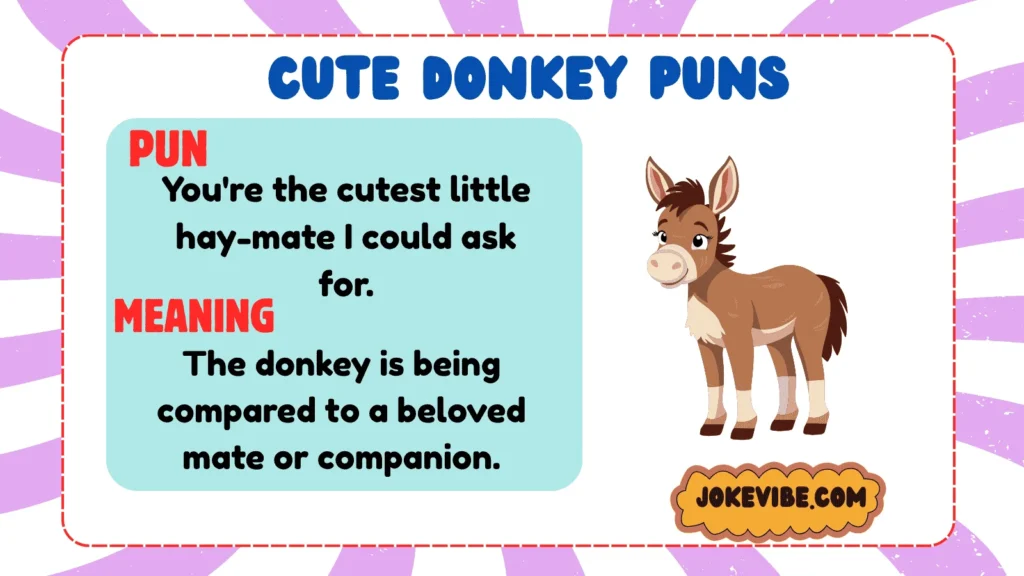
The Pun
“You’re the cutest little hay-mate I could ask for.”
Meaning: The donkey is being compared to a beloved mate or companion.
Why It’s Funny: Hay gives the ordinary word a farm-friendly twist.
Best Used For: Animal photos and friendship captions.
The Pun
“Donkey believe how much I adore you.”
Meaning: The speaker is emphasizing how much they love someone.
Why It’s Funny: Donkey replaces don’t in a familiar phrase.
Best Used For: Cute cards, texts, and animal posts.
The Pun
“You make my heart go hee-haw over heels.”
Meaning: Someone makes the speaker completely smitten.
Why It’s Funny: It combines head over heels with the donkey’s famous vocal sound.
Best Used For: Romantic captions and Valentine’s messages.
The Pun
“Life is better with a little hay and a lot of heart.”
Meaning: Simple pleasures and affection make life better.
Why It’s Funny: The wholesome message gets a subtle donkey makeover.
Best Used For: Farm photos, family posts, and greeting cards.
The Pun
“Some friendships are simply bray-mazing.”
Meaning: The friendship is amazing.
Why It’s Funny: Amazing gets a donkey-sound makeover.
Best Used For: Best-friend captions and friendship cards.
The Pun
“You are my favorite pasture person.”
Meaning: The person is a favorite companion in a playful farm setting.
Why It’s Funny: Pasture sounds like past your, giving the phrase a second layer.
Best Used For: Cute friendship posts.
The Pun
“Sending you a big donkey hug and a tiny bray of sunshine.”
Meaning: A warm, cheerful message.
Why It’s Funny: It combines exaggerated affection with donkey imagery.
Best Used For: Good-morning texts, encouragement cards, and animal lovers.
Donkey One-Liners
One-liners are perfect when you don’t want a long setup. They’re quick, punchy, and easy to paste into a caption or message.
The best donkey one-liners usually contain one strong idea and one clear twist. They don’t need explanation unless the recipient is still recovering from the groan.
Use these whenever you need humor in a hurry.
The Pun
“Stay stubborn. Stay fabulous. Stay out of the mud.”
Meaning: A playful confidence message inspired by donkey behavior.
Why It’s Funny: It treats stubbornness like a glamorous personality trait.
Best Used For: Social media captions.
The Pun
“I’m having a bray day.”
Meaning: A playful version of saying you’re having a great day.
Why It’s Funny: It gives great or good day language a donkey-style sound.
Best Used For: Morning posts and animal selfies.
The Pun
“Hay there, handsome.”
Meaning: A playful greeting for someone attractive.
Why It’s Funny: Hey becomes hay.
Best Used For: Flirty messages and donkey photos.
The Pun
“No drama. Just brama.”
Meaning: Avoid drama and replace it with donkey energy.
Why It’s Funny: The familiar word drama gets transformed by a donkey sound.
Best Used For: Short captions.
The Pun
“I’m not stubborn. I’m selectively flexible.”
Meaning: The speaker refuses to admit they’re stubborn.
Why It’s Funny: It’s a humorous euphemism for refusing to change.
Best Used For: Personality captions and self-deprecating humor.
The Pun
“Hoofing it through life one bad decision at a time.”
Meaning: Moving through life while making questionable choices.
Why It’s Funny: Hoofing it becomes a literal donkey-related expression.
Best Used For: Travel photos and funny life updates.
The Pun
“Just out here making hay while the mood is right.”
Meaning: Enjoying the moment rather than worrying about productivity.
Why It’s Funny: It gives the old phrase make hay while the sun shines a more casual twist.
Best Used For: Vacation and weekend captions.
Donkey Dad Jokes
Dad jokes and donkey puns are practically cousins. Both depend on clean wordplay, predictable setups, and punchlines that make people laugh while pretending they didn’t.
The beauty of a dad joke is that it doesn’t need to be sophisticated. In fact, the more obvious the groan, the better.
These donkey dad jokes are safe for family gatherings, school events, road trips, and group chats.
The Pun
“Why did the donkey bring a ladder to the barn? He wanted to move up in the stable business.”
Meaning: The donkey wants to improve his position.
Why It’s Funny: Move up becomes literal while stable business references the barn.
Best Used For: Family gatherings and kids’ jokes.
The Pun
“Why did the donkey become a musician? He had perfect bray-timing.”
Meaning: The donkey has excellent musical timing.
Why It’s Funny: Great timing or bray timing connects music with the animal’s sound.
Best Used For: Music jokes and children’s humor.
The Pun
“Why was the donkey such a good employee? He was always willing to hoof the work.”
Meaning: The donkey works hard.
Why It’s Funny: Do the work becomes hoof the work.
Best Used For: Workplace humor.
The Pun
“Why did the donkey sit in the shade? He didn’t want to work his tail off.”
Meaning: The donkey wanted to relax instead of work hard.
Why It’s Funny: It takes a familiar expression and makes the donkey’s body part part of the joke.
Best Used For: Summer jokes and family humor.
The Pun
“Why did the donkey refuse the shortcut? He had already committed to his long-haul personality.”
Meaning: The donkey is stubborn and prefers doing things his own way.
Why It’s Funny: It turns a travel decision into a personality trait.
Best Used For: Road-trip humor.
The Pun
“Why did the donkey get promoted? He was outstanding in his field.”
Meaning: The donkey literally stands in a field.
Why It’s Funny: The phrase outstanding in his field normally means someone excels at their profession.
Best Used For: Classic-style dad humor.
The Pun
“Why did the donkey start a podcast? He had a lot to bray about.”
Meaning: The donkey has many opinions to share.
Why It’s Funny: A lot to say becomes a lot to bray about.
Best Used For: Podcast jokes, social media, and creator humor.
Donkey Puns for Kids
Kids love animal jokes because they’re visual, easy to understand, and usually silly. Donkey puns are particularly useful for classrooms, children’s books, farm visits, animal projects, and family activities.
For younger audiences, the safest approach is to focus on hay, hooves, ears, barns, fields, braying, and farm life. Avoid wordplay that depends on adult meanings of “ass.”
The following jokes keep the humor playful and classroom-friendly.
The Pun
“The donkey said, ‘Hay!’ because he didn’t know how to say hello.”
Meaning: The donkey uses hay instead of hey.
Why It’s Funny: Children can easily recognize the sound-alike joke.
Best Used For: Preschool and elementary classrooms.
The Pun
“That donkey has big ears because he likes to hear all the farm gossip.”
Meaning: The donkey’s large ears are turned into a listening superpower.
Why It’s Funny: It gives a silly reason for a real animal feature.
Best Used For: Kids’ stories and animal activities.
The Pun
“The donkey wanted to be a singer, but his favorite note was always ‘hee-haw.'”
Meaning: The donkey’s natural sound becomes his musical style.
Why It’s Funny: It treats a donkey’s bray like a musical note.
Best Used For: Music lessons and children’s jokes.
The Pun
“The donkey packed hay for lunch because he wanted a snack with plenty of straw-nge flavor.”
Meaning: The donkey enjoys a very unusual lunch.
Why It’s Funny: It creates a silly invented word from strange and straw.
Best Used For: Creative writing activities.
The Pun
“The donkey’s favorite school subject is stable studies.”
Meaning: The donkey studies something related to the stable.
Why It’s Funny: It sounds like a real school subject while referring to his home.
Best Used For: Classroom jokes.
The Pun
“The donkey became a detective because nobody could hide anything from those ears.”
Meaning: The donkey is imagined as an excellent investigator.
Why It’s Funny: His large ears become detective equipment.
Best Used For: Children’s stories and classroom storytelling.
The Pun
“The donkey wanted a vacation, so he booked a trip to the hay-ways.”
Meaning: The donkey goes on a holiday.
Why It’s Funny: Highways becomes hay-ways.
Best Used For: Travel activities and kids’ captions.
Donkey Birthday Puns
Birthday cards are one of the easiest places to use donkey wordplay. The humor works because birthdays already invite playful exaggeration.
A good birthday donkey pun should feel celebratory rather than forced. You can make the birthday person the star of the joke, or simply use the donkey as a silly theme.
These are suitable for friends, family members, coworkers, and animal-loving birthday celebrants.
The Pun
“Hope your birthday is absolutely bray-illiant!”
Meaning: A wish for an excellent birthday.
Why It’s Funny: Brilliant gets a donkey-inspired sound twist.
Best Used For: Birthday cards and social posts.
The Pun
“Hay, birthday legend! Another year wiser, sassier, and slightly more stubborn.”
Meaning: A playful compliment about getting older.
Why It’s Funny: It treats stubbornness as an admirable birthday trait.
Best Used For: Friends and siblings.
The Pun
“Have a hoof-tastic birthday!”
Meaning: A wish for a fantastic birthday.
Why It’s Funny: Hoof replaces the beginning of fantastic.
Best Used For: Children’s cards and animal lovers.
The Pun
“Donkey worry about getting older. You’re still young at bray.”
Meaning: Age shouldn’t be taken too seriously.
Why It’s Funny: It replaces heart or age language with bray.
Best Used For: Funny birthday messages.
The Pun
“Another trip around the sun? That’s something to bray about!”
Meaning: Celebrating another year of life.
Why It’s Funny: The normal expression something to brag about becomes donkey-themed.
Best Used For: Social media birthday captions.
The Pun
“May your birthday be filled with cake, confetti, and zero stubborn relatives.”
Meaning: A humorous wish for a peaceful celebration.
Why It’s Funny: It connects the donkey stereotype of stubbornness with family gatherings.
Best Used For: Family birthday cards.
The Pun
“You’re not getting older. You’re just becoming a more experienced hay-sonality.”
Meaning: Aging is reframed as developing personality.
Why It’s Funny: Personality becomes a ridiculous hay-based invention.
Best Used For: Close friends who appreciate absurd humor.
Donkey Love Puns
Romantic donkey puns can be surprisingly charming when the jokes stay light. They’re perfect for Valentine’s Day, anniversary messages, cute texts, and animal-themed relationship posts.
The best romantic animal puns don’t try too hard to sound poetic. A little silliness makes them more memorable.
The Pun
“I love you more than a donkey loves a fresh pile of hay.”
Meaning: The speaker is expressing enormous affection.
Why It’s Funny: It uses the donkey’s imagined enthusiasm for hay as a ridiculous comparison.
Best Used For: Valentine’s cards and texts.
The Pun
“You’re the one who makes my heart go hee-haw.”
Meaning: Someone makes the speaker feel excited and in love.
Why It’s Funny: It replaces the normal romantic language with a donkey sound.
Best Used For: Cute romantic captions.
The Pun
“I can’t bray-lieve how lucky I am to have you.”
Meaning: The speaker feels very fortunate in the relationship.
Why It’s Funny: Believe gets transformed into bray-lieve.
Best Used For: Anniversary messages.
The Pun
“You and me? That’s one stable relationship.”
Meaning: The relationship is strong and dependable.
Why It’s Funny: Stable describes both a healthy relationship and a donkey’s home.
Best Used For: Anniversary cards.
The Pun
“I’d cross every pasture just to find you.”
Meaning: The speaker would go far for their loved one.
Why It’s Funny: It gives a romantic statement a farm-themed setting.
Best Used For: Cute texts and captions.
The Pun
“You’re my favorite hay-mate for life.”
Meaning: The loved one is the speaker’s favorite companion.
Why It’s Funny: Hey, mate becomes hay-mate.
Best Used For: Couples’ captions.
The Pun
“Our love is stubborn enough to last forever.”
Meaning: The relationship is extremely strong.
Why It’s Funny: A normally negative donkey trait becomes a romantic compliment.
Best Used For: Anniversary messages and relationship posts.
Donkey Instagram Captions
A good Instagram caption should be short enough to scan quickly but distinctive enough to earn a smile.
Donkey photos already provide visual humor, so the caption doesn’t need to explain everything. Sometimes one strong pun is better than a paragraph.
Use these for farm photos, animal selfies, travel pictures, countryside posts, or any picture where a donkey has unexpectedly become the main character.
The Pun
“Hay, internet. Meet my new best friend.”
Meaning: A playful introduction to a donkey.
Why It’s Funny: Hey becomes hay.
Best Used For: Donkey introduction posts.
The Pun
“Living my best pasture life.”
Meaning: Enjoying a peaceful life.
Why It’s Funny: Pasture creates a playful farm version of a lifestyle phrase.
Best Used For: Countryside photos.
The Pun
“Ears up, worries down.”
Meaning: Stay positive and carefree.
Why It’s Funny: It turns the donkey’s distinctive ears into a motivational image.
Best Used For: Animal portraits.
The Pun
“Too cute to mule-tiny.”
Meaning: The donkey is too cute to ignore.
Why It’s Funny: It bends the word mighty or multitask into mule-related wordplay.
Best Used For: Cute animal pictures.
The Pun
“Currently accepting hay and compliments.”
Meaning: The donkey wants treats and praise.
Why It’s Funny: It gives the animal a human-like social-media personality.
Best Used For: Funny donkey portraits.
The Pun
“No bad days, just bray days.”
Meaning: Keep a positive attitude.
Why It’s Funny: Bad days becomes bray days, giving the caption a donkey twist.
Best Used For: Cheerful Instagram posts.
The Pun
“Serving serious ears energy.”
Meaning: The donkey’s ears are the star of the picture.
Why It’s Funny: It turns a physical trait into a trendy social-media expression.
Best Used For: Close-up donkey photos.
Donkey Puns for TikTok and Facebook
Short-form social media rewards humor that works immediately. On TikTok, the visual moment can carry most of the joke while the caption adds the final punch. Facebook tends to give slightly more room for storytelling, making donkey puns useful for family posts, farm updates, and funny animal videos.
The strongest social media puns are conversational. They sound like something a real person might actually say.
The Pun
“POV: You asked the donkey to hurry up.”
Meaning: The donkey predictably refuses to move quickly.
Why It’s Funny: It uses a familiar social-media format and the animal’s stubborn reputation.
Best Used For: TikTok videos.
The Pun
“When your plans change but your donkey has already made up his mind.”
Meaning: The donkey refuses to adapt.
Why It’s Funny: It personifies the animal’s stubbornness.
Best Used For: Reaction videos and memes.
The Pun
“Me pretending I have my life together: absolutely stable.”
Meaning: The speaker jokes about appearing organized.
Why It’s Funny: Stable refers to both emotional stability and a donkey’s home.
Best Used For: TikTok captions and Facebook posts.
The Pun
“This donkey understood the assignment. The assignment was snacks.”
Meaning: The donkey is focused entirely on food.
Why It’s Funny: It uses modern internet phrasing for a very simple animal motivation.
Best Used For: Feeding videos.
The Pun
“Tell me you’re stubborn without telling me you’re stubborn.”
Meaning: The donkey demonstrates stubborn behavior.
Why It’s Funny: It uses a familiar social-media format to highlight the animal’s personality.
Best Used For: Donkey videos.
The Pun
“Today’s forecast: 100% chance of hay.”
Meaning: The donkey expects food.
Why It’s Funny: A weather forecast is repurposed for farm life.
Best Used For: Facebook photos and short videos.
The Pun
“The comments section wanted drama. The donkey brought brama.”
Meaning: The donkey creates its own version of drama.
Why It’s Funny: Drama gets a donkey-sound makeover.
Best Used For: Funny reaction posts.
Donkey Puns for Teachers and Classrooms
Teachers can use animal puns as warm-up jokes, writing prompts, bulletin-board captions, vocabulary activities, or quick classroom humor.
Donkey jokes are especially useful because they can introduce homophones, compound words, idioms, animal vocabulary, and creative writing.
For younger students, keep the language clean and focus on hay, hooves, ears, barns, and braying.
The Pun
“Let’s not make a big bray-k about it.”
Meaning: Don’t make a big deal about something.
Why It’s Funny: Break or break language gets transformed into donkey wordplay.
Best Used For: Classroom transitions.
The Pun
“Today we’re going to hoof it through our homework.”
Meaning: Students will work through homework quickly.
Why It’s Funny: Hoof it is a familiar expression that becomes literal.
Best Used For: Homework reminders.
The Pun
“Hay, class! Ready to learn something new?”
Meaning: A playful greeting.
Why It’s Funny: Hey becomes hay.
Best Used For: Classroom greetings.
The Pun
“Keep your ideas stable, but let your imagination run wild.”
Meaning: Stay focused while being creative.
Why It’s Funny: Stable connects to the donkey’s home.
Best Used For: Creative writing lessons.
The Pun
“This assignment may look hard, but don’t give up your bray-vity.”
Meaning: Students should stay brave.
Why It’s Funny: Bravery receives a donkey-themed twist.
Best Used For: Encouragement.
The Pun
“Our class has hoofed it through another great lesson.”
Meaning: The class successfully completed the lesson.
Why It’s Funny: Moved through becomes hoofed through.
Best Used For: End-of-class humor.
The Pun
“Remember: great ideas don’t grow on trees. Sometimes they grow in the hay.”
Meaning: Creativity can come from unexpected places.
Why It’s Funny: It turns an ordinary saying into a farm-themed lesson.
Best Used For: Writing classes and bulletin boards.
Donkey Puns for Greeting Cards
Greeting cards give puns a little more room to breathe. You can combine a short joke with a sincere message so the recipient gets both a laugh and a thoughtful note.
Donkey humor works especially well for congratulations, encouragement, thank-you notes, friendship cards, and general “thinking of you” messages.
The Pun
“Hay friend, just wanted to remind you that you’re bray-illiant.”
Meaning: A friend is being praised.
Why It’s Funny: Two familiar words get subtle donkey transformations.
Best Used For: Friendship cards.
The Pun
“Donkey forget how awesome you are.”
Meaning: Don’t forget that you’re wonderful.
Why It’s Funny: Don’t becomes donkey.
Best Used For: Encouragement cards.
The Pun
“Sending you a little hay, a lot of sunshine, and one enormous donkey smile.”
Meaning: A cheerful message of encouragement.
Why It’s Funny: It creates an exaggerated donkey-themed package of positivity.
Best Used For: Get-well and encouragement cards.
The Pun
“You’re one of the few people I’d happily cross a whole pasture for.”
Meaning: The friendship is valuable enough to make a big effort.
Why It’s Funny: It turns affection into a silly farm adventure.
Best Used For: Close friends.
The Pun
“Thanks for always being my stable support.”
Meaning: Thanking someone for being dependable.
Why It’s Funny: Stable carries both emotional and donkey-related meanings.
Best Used For: Thank-you cards.
The Pun
“Hope your day is full of good vibes and zero stubborn situations.”
Meaning: A wish for a peaceful day.
Why It’s Funny: It references the donkey’s most famous personality trait.
Best Used For: Everyday cards.
The Pun
“You make every day a little more hay-py.”
Meaning: You make life happier.
Why It’s Funny: Happy becomes hay-py.
Best Used For: Sweet friendship and family cards.
Donkey Puns for Marketing and Content Creators
Animal humor can work well in marketing when the audience already enjoys playful brand voices. Donkey puns can make an otherwise ordinary headline feel more memorable.
For bloggers and creators, the biggest advantage is flexibility. A donkey pun can become a headline, caption, email subject line, product tagline, meme, social hook, or section introduction.
The important thing is relevance. Don’t force a donkey pun into a serious message simply because you can. Humor works best when it matches the brand and audience.
The Pun
“Don’t be stubborn about better results.”
Meaning: Encourage customers to consider a better solution.
Why It’s Funny: It connects a business decision with donkey behavior.
Best Used For: Marketing campaigns.
The Pun
“Hay, we’ve got something bray-mazing for you.”
Meaning: Introducing an exciting product or offer.
Why It’s Funny: The familiar promotional phrase gets donkey-themed wording.
Best Used For: Social ads and promotional posts.
The Pun
“Our customers don’t follow the herd. They choose their own pasture.”
Meaning: Customers are independent.
Why It’s Funny: It combines individuality with farm imagery.
Best Used For: Lifestyle brands.
The Pun
“A stable choice for unstable days.”
Meaning: The product provides reliability.
Why It’s Funny: The double meaning of stable creates the hook.
Best Used For: Service businesses.
The Pun
“We take quality seriously. The donkey handles the fun.”
Meaning: The brand balances professionalism and personality.
Why It’s Funny: It creates a fictional donkey employee.
Best Used For: Brand storytelling.
The Pun
“Don’t just follow the path. Hoof your own way.”
Meaning: Be independent.
Why It’s Funny: Go your own way becomes a donkey-themed statement.
Best Used For: Personal brands and motivational campaigns.
The Pun
“Good ideas are worth their hay weight in gold.”
Meaning: Great ideas are extremely valuable.
Why It’s Funny: Weight in gold is replaced with a hay-based expression.
Best Used For: Blogging, creative agencies, and marketing posts.
How to Use Donkey Puns
A pun becomes more effective when you match it to the situation.
A funny donkey joke that works brilliantly on TikTok may feel strange inside a formal email. Likewise, a cute pun that works on a birthday card may not have enough energy for a meme.
Think about audience, context, length, and purpose before choosing your joke.
For social media, short captions usually perform better because the image or video supplies the context.
For greeting cards, you can add a pun followed by a sincere message.
For classrooms, choose clean wordplay that teaches something about language.
For blogs, use donkey puns as section openers, examples, captions, or creative hooks rather than filling every paragraph with jokes.
For marketing, make sure the pun supports the product or message. A clever joke should make the brand more memorable, not distract from what you’re selling.
You can also adjust the intensity of the humor. A simple hay there joke works for almost anyone. More complicated wordplay is better suited to people who already enjoy puns.
How to Create Your Own Donkey Puns
Creating original donkey puns becomes much easier once you stop trying to invent a joke from nothing.
Start with a list of donkey-related words:
- Hay
- Bray
- Hoof
- Stable
- Saddle
- Mule
- Pasture
- Barn
- Ears
- Tail
- Farm
- Field
- Stubborn
- Ride
- Trail
Then create a second list of common phrases.
For example:
- Have a great day
- Make your own way
- Out of the box
- Worth its weight in gold
- Go the extra mile
- Stay positive
- Follow your heart
- Think outside the box
- Make hay while the sun shines
Now look for places where the words can overlap.
Have a great day can become have a great bray.
Make your own way can become hoof your own way.
Stay positive can become stay pasture-positive.
You don’t need to change every word. Often, changing just one word creates the funniest result.
Another useful technique is double meaning.
Words like stable already have a normal meaning and an animal-related meaning. That gives you a natural pun without forcing the joke.
Finally, read your pun aloud.
If it sounds like something nobody would actually say, revise it. Great wordplay should feel effortless even when the construction behind it wasn’t.
Where to Use Donkey Puns
Social Media
Donkey puns are perfect for social media because they are short, visual, and easy to share. Pair a joke with a funny animal photo or video for extra impact.
Use donkey puns as captions for animal portraits, farm visits, countryside photos, vacations, or funny selfies.
Short lines such as “Living my best pasture life” are especially useful when the image already tells most of the story.
TikTok
TikTok gives you the opportunity to make the visual action the setup and use the pun as the payoff.
A stubborn donkey refusing to move is practically a ready-made comedy scene.
Facebook works well for slightly longer donkey stories, family humor, animal posts, and funny farm updates.
Greeting Cards
Use a donkey pun as the opening line, then follow it with a sincere message. This keeps the card funny without making it feel impersonal.
Birthday Cards
Birthday donkey jokes work particularly well for friends who enjoy silly humor. Pair a pun with a genuine birthday wish.
Marketing
Brands can use donkey wordplay to create memorable headlines, especially when their voice is playful or family-friendly.
Always make sure the pun reinforces the marketing message.
Teachers
Teachers can use donkey jokes to introduce homophones, vocabulary, creative writing, idioms, and animal-related lessons.
Blogs
Bloggers can use donkey puns in headlines, introductions, image captions, social snippets, and examples of creative wordplay.
Conversation
Sometimes the best place for a donkey pun is simply a normal conversation.
If someone says they’re being stubborn, you have an opening.
If someone mentions a farm, hay, horses, or a long walk, you have another.
The secret is timing. Don’t force the pun into every sentence.
Common Mistakes When Writing Donkey Puns
The biggest mistake is forcing the word “donkey” into a sentence that doesn’t naturally support it.
A pun should create a connection between two meanings. If the reader has to decode the sentence for ten seconds, the joke probably needs work.
Another common mistake is repetition.
Once you’ve used hay there, you don’t need six variations of the same joke. Strong pun collections work because each joke takes a slightly different route.
Avoid relying entirely on the word ass, too. While it can create obvious wordplay, using it repeatedly makes an article feel predictable and can reduce its usefulness for families, teachers, and brands.
Another problem is explaining too much.
A pun’s explanation should clarify the wordplay, not become longer than the joke itself.
Finally, remember the audience.
A children’s classroom needs clean humor. A close-friends group chat can handle edgier wordplay. A professional brand may need something much more subtle.
Tips for Writing Better Donkey Puns
Start with familiar phrases. They’re easier to twist than completely original sentences.
Use sound-alike words. Hay and hey are natural examples.
Exploit double meanings. Stable is especially useful because it works naturally in both animal and everyday contexts.
Keep the punchline short. The longer the setup, the more obvious the joke can become.
Use the donkey’s personality. Stubbornness is a strong comedic character trait.
Mix cute and clever. A collection becomes more interesting when every joke doesn’t sound the same.
Read jokes aloud. If the wording feels awkward when spoken, rewrite it.
Match the audience. Family humor, classroom humor, romantic humor, and marketing humor require different approaches.
Don’t over-pun. A single strong joke is usually better than five weak ones.
Create visual connections. Donkey ears, hooves, hay, barns, and pastures can all inspire captions that work especially well with images.
Related Pun Ideas to Explore
If you’re building a larger collection of animal, food, or everyday wordplay, donkey puns can easily lead into other pun categories.
Consider creating related content around:
- Banana Puns
- Orange Puns
- Food Puns
- Pumpkin Puns
- Horse Puns
- Cow Puns
- Farm Puns
- Animal Puns
- Dad Jokes
- Funny Captions
- Birthday Puns
- Cute Puns
- Funny One-Liners
These topics can also create useful internal-link opportunities when building a broader humor website. Linking closely related pun categories helps readers discover more content while creating a stronger topical relationship between articles.
FAQs
What is a donkey pun?
A donkey pun is a joke that uses donkey-related words, sounds, traits, or farm imagery to create a humorous twist on a familiar word or phrase.
What are some funny donkey words for puns?
Useful donkey-pun words include hay, bray, hoof, stable, saddle, mule, pasture, barn, ears, tail, field, and stubborn.
What is a good donkey pun for Instagram?
A short caption such as “Living my best pasture life” works well because it is quick, visual, and easy to understand.
Are donkey puns suitable for kids?
Yes. Many donkey puns can be completely family-friendly. For children, focus on hay, hooves, ears, barns, fields, and braying rather than adult wordplay involving the word “ass.”
What makes a good donkey pun?
A good donkey pun usually combines a familiar phrase with a natural donkey-related twist. The strongest examples are short, easy to understand, and don’t require a long explanation.
Can I use donkey puns in birthday cards?
Absolutely. Donkey birthday puns work well for friends, family members, children, and anyone who enjoys silly animal humor.
How can I make my own donkey puns?
Start with donkey words such as hay, hoof, bray, and stable. Then pair them with common phrases and look for sound-alike words, double meanings, or opportunities to replace one word.
Why are donkey puns so funny?
Donkey puns combine familiar language with recognizable animal traits. The contrast between an ordinary expression and an unexpected donkey twist creates the surprise that makes the joke work.
Final Thoughts
The best donkey puns don’t take themselves too seriously, and that’s exactly why they work. A donkey already brings plenty of personality to the table: big ears, a memorable bray, an appetite for hay, and a reputation for being wonderfully stubborn.
That gives writers a surprisingly large playground for wordplay.
You can make donkey jokes cute, clever, silly, romantic, educational, sarcastic, or completely ridiculous depending on your audience. A single word such as hay can become a greeting. Stable can become a relationship joke. Hoof can transform an ordinary expression into something unexpectedly funny.
That’s also why these puns work across so many situations.
Use them on Instagram and TikTok when you need a caption. Put one in a birthday or greeting card when a normal message feels too predictable. Give one to a teacher looking for clean classroom humor. Add one to a blog, marketing campaign, or creative project when you want a memorable hook. Or simply drop one into a conversation when everyone needs a quick laugh.
Most importantly, don’t stop with the puns on this page.
Use them as inspiration to create your own. Start with an everyday phrase, find a donkey-related word that sounds similar, and twist the meaning. Keep the wording natural, keep the punchline quick, and don’t be afraid of a good groan.
After all, a truly great pun doesn’t need everyone to applaud.
Sometimes, making someone roll their eyes while secretly smiling is the whole bray-son you’re telling it.

I’m Naqash Ayub, and I believe a great pun can make any day better. At Jokevibe, I create original wordplay, witty jokes, and fun content that’s simple to read, easy to share, and guaranteed to bring a smile.


